Red, White, and Blue Dress

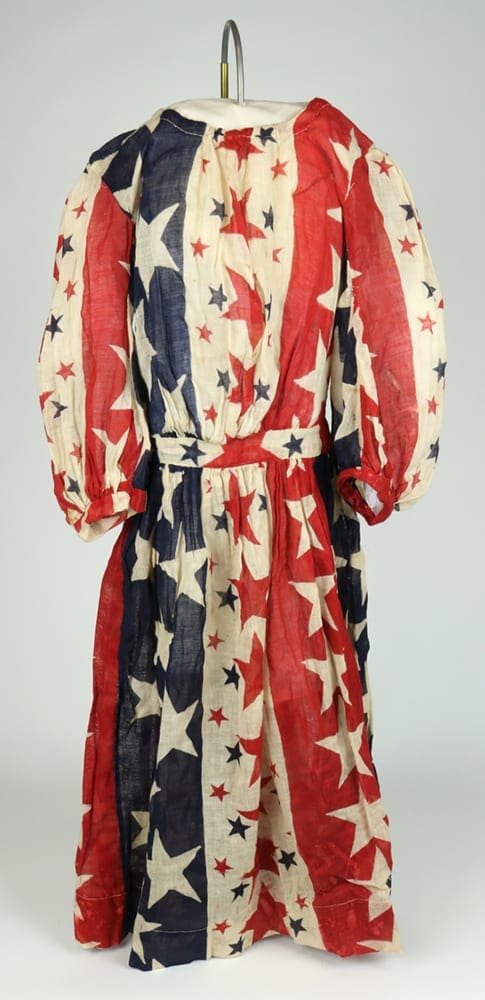
Red, white, and blue dress, circa 1910Donated by Mary Brashears Mullen

Jessie Stewart (1892-1980) showed her patriotic spirit when she wore this dress to the annual reunion at St. Paul (Madison County). The dress dates to about 1901, so Jessie would have been about  ten years old when she wore it.

Jessie was born in Hazard, Kentucky, to James M. and Margaret Elizabeth Brashears Stewart. In 1895, the family moved to St. Paul where James ran a mercantile. Jessie attended school in St. Paul, then studied music at the University of Arkansas. Following graduation from college, she taught school in Oklahoma and in the Northwest Arkansas communities of Bentonville and Cave Springs. In 1925 she married Thomas Jacob “Jake” Gilstrap, a lumber yard operator she first met in St. Paul. Jake opened his first lumber yard in Combs (Madison County) in 1915 and went on to own lumber yards in Texas, Kansas, and Northwest Arkansas.

When Jake died in 1946, Jessie moved to Bentonville to run the family lumber business there. She became a successful businesswoman, well-known in the retail lumber trade as “Lumber Lou,” whose columns appeared regularly in trade publications for over thirty years.

Red, white, and blue dress, circa 1910

Donated by Mary Brashears Mullen

Jessie Stewart (1892-1980) showed her patriotic spirit when she wore this dress to the annual reunion at St. Paul (Madison County). The dress dates to about 1901, so Jessie would have been about  ten years old when she wore it.

Jessie was born in Hazard, Kentucky, to James M. and Margaret Elizabeth Brashears Stewart. In 1895, the family moved to St. Paul where James ran a mercantile. Jessie attended school in St. Paul, then studied music at the University of Arkansas. Following graduation from college, she taught school in Oklahoma and in the Northwest Arkansas communities of Bentonville and Cave Springs. In 1925 she married Thomas Jacob “Jake” Gilstrap, a lumber yard operator she first met in St. Paul. Jake opened his first lumber yard in Combs (Madison County) in 1915 and went on to own lumber yards in Texas, Kansas, and Northwest Arkansas.

When Jake died in 1946, Jessie moved to Bentonville to run the family lumber business there. She became a successful businesswoman, well-known in the retail lumber trade as “Lumber Lou,” whose columns appeared regularly in trade publications for over thirty years.

Eaton Family

Eaton family at the Boston (Madison County) school and church building, early 1940s. From left: Lillian Bennett Eaton holding Levell, Elbie L.”Hoss” Eaton holding Kenneth, Katherine “Kay” Eaton standing in front.

Otto Bennett Collection (S- 2000-64-380)

Eaton family at the Boston (Madison County) school and church building, early 1940s. From left: Lillian Bennett Eaton holding Kenneth, Elbie L.”Hoss” Eaton holding Levell, Katherine “Kay” Eaton standing in front.

Otto Bennett Collection (S- 2000-64-380)

Picking Beans

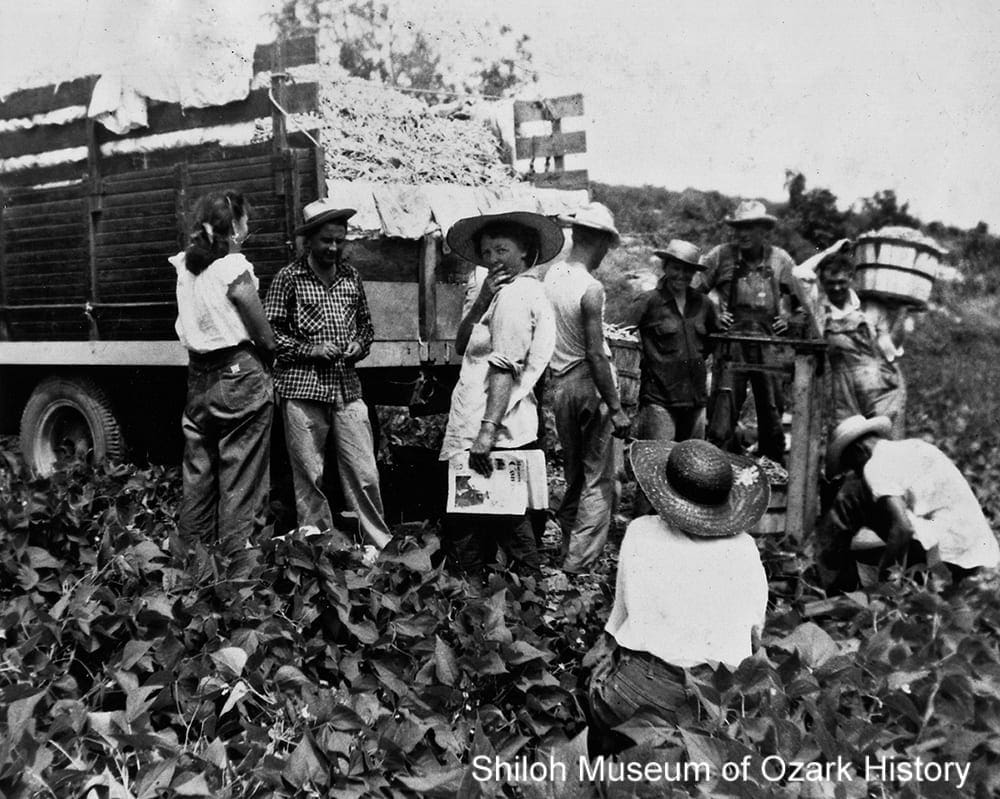
Picking beans at the McGarrah farm near Siloam Springs (Benton County), July 1, 1955. Standing, from left: Mrs. Bob Anderson, Bob Anderson, Geneva McGarrah Bauer, unidentified, Tom Anderson, Tom Alverson, Tom Alverson (bushel basket on shoulder). Crouched, from left: Pearl McGarrah, Jack Bauer.

Geneva Bauer (the woman looking at the camera) is holding a list of basket weights used to estimate the pounds of beans picked. Workers was paid ten cents per pound of beans. This truckload was headed for Dallas to fresh-market buyers.

Mr. and Mrs. Jack Bauer Collection (S-92-144)

PIcking beans at the McGarrah farm near Siloam Springs (Benton County), July 1, 1955. Standing, from left: Mrs. Bob Anderson, Bob Anderson, Geneva McGarrah Bauer, unidentified, Tom Anderson, Tom Alverson, Tom Alverson (bushel basket on shoulder). Crouched, from left: Pearl McGarrah, Jack Bauer.

Geneva Bauer (the woman looking at the camera) is holding a list of basket weights used to estimate the pounds of beans picked. Workers was paid ten cents per pound of beans. This truckload was headed for Dallas to fresh-market buyers.

Mr. and Mrs. Jack Bauer Collection (S-92-144)

Ozark Nuthead Dolls

Ozark nuthead dolls“Hillbilly Wedding,” a hickory nut doll diorama, was made by Ben Smith and his wife, Ethel. The Smiths, who lived in the Fayetteville/Springdale area, made dolls and other souvenir items in the late 1940s which were sold locally and by mail order. The Smiths’ son Lavon helped with the souvenir business while attending the University of Arkansas, where he studied art.

The Shiloh Museum purchased “Hillbilly Wedding” from doll collector Hilda Geuther of Eureka Springs.

Ozark nuthead dolls

“Hillbilly Wedding,” a hickory nut doll diorama, was made by Ben Smith and his wife, Ethel. The Smiths, who lived in the Fayetteville/Springdale area, made dolls and other souvenir items in the late 1940s which were sold locally and by mail order. The Smiths’ son Lavon helped with the souvenir business while attending the University of Arkansas, where he studied art.

The Shiloh Museum purchased “Hillbilly Wedding” from doll collector Hilda Geuther of Eureka Springs.

Brogdon and Hazel Produce Warehouse

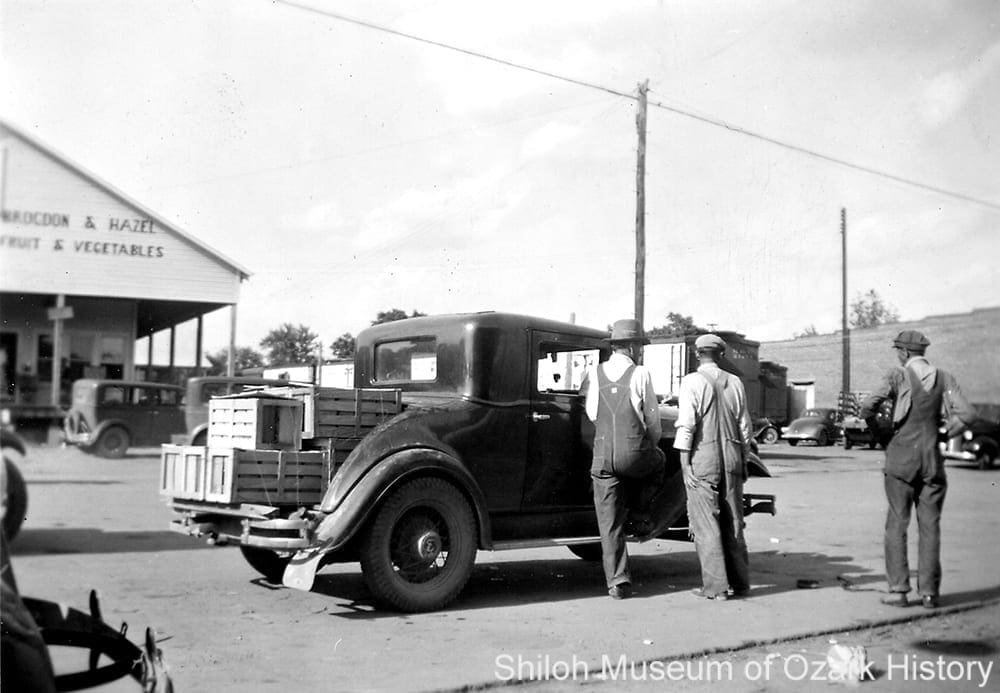
Brogdon and Hazel produce warehouse on Emma Avenue, Springdale, circa 1939. Forrest Hazel and Preston Brogdon ran a bustling wholesale produce market for more than thirty years, during Springdale’s heyday as an agricultural hub where crops which were shipped out or processed locally.

In the 1930s, artist Natalie Henry was hired to paint a WPA mural for Springdale’s post office. She spent time in Springdale taking photos as a way to inform her artwork, including this scene at Brogdon and Hazel’s warehouse.

Today, Natalie Henry’s mural, “Local Industries,” hangs in the Shiloh Museum. Learn more about the mural under the “New Deal” section of our 1920 to 1950 online exhibit.

Natalie Henry, photographer. Martha Hall Collection (S-96-112-15)

Brogdon and Hazel produce wholesale warehouse on Emma Avenue, Springdale, Arkansas, circa 1939

Brogdon and Hazel produce warehouse on Emma Avenue, Springdale, circa 1939. Forrest Hazel and Preston Brogdon ran a bustling wholesale produce market for more than thirty years, during Springdale’s heyday as an agricultural hub where crops which were shipped out or processed locally.

In the 1930s, artist Natalie Henry was hired to paint a WPA mural for Springdale’s post office. She spent time in Springdale taking photos as a way to inform her artwork, including this scene at Brogdon and Hazel’s warehouse.

Today, Natalie Henry’s mural, “Local Industries,” hangs in the Shiloh Museum. Learn more about the mural under the “New Deal” section of our 1920 to 1950 online exhibit.

Natalie Henry, photographer. Martha Hall Collection (S-96-112-15)

Jigsaw Puzzle

Donated by Robert Winn

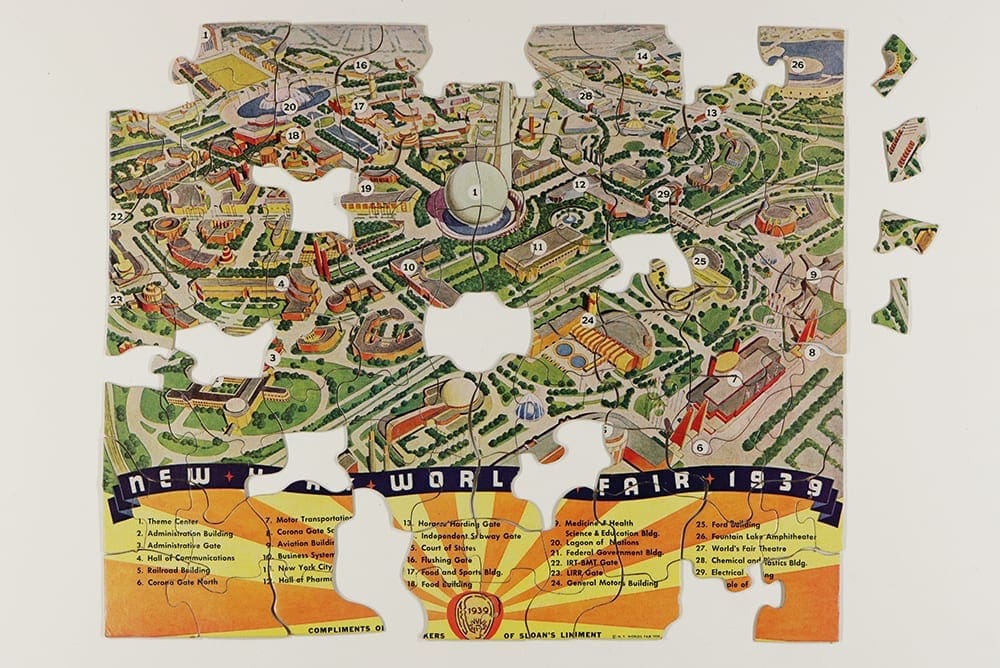
1939 Worlds' Fair jigsaw puzzleThis jigsaw puzzle was a souvenir of the 1939 New York’s World’s Fair held at Flushing Meadows-Corona Park in Queens, New York. With a slogan of “Dawn of a New Day,”  the fair opened on April 30, 1939, the anniversary of George Washington’s inauguration. At cost of $160 million, the 1939 World’s Fair’s price tag was second only to the St. Louis Louisiana Purchase Exposition of 1904. 

As part of the fair’s festivities, Westinghouse Electric and Manufacturing Company prepared a time capsule that was buried in 1938 and sealed in 1939. Among its contents are copies of Life magazine, a kewpie doll, a pack of cigarettes, a hat made by famed designer Lilly Daché, microfilmed copies of an almanac, a dictionary, and a Sears Roebuck catalog, and an RKO newsreel. The time capsule is scheduled to be reopened 5000 years after it was sealed, in 6939.

The 1939 World’s Fair ran through the fall of 1940 and attracted more than 44 million visitors.

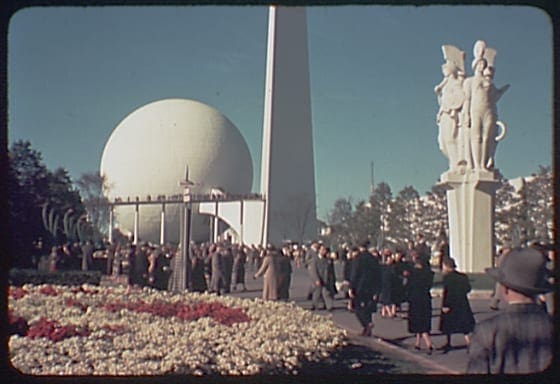
1939 World's Fair, showing the Perisphere, Trylon, and Four Victories of Peace sculpture.

1939 World’s Fair, showing the Theme Center (No. 1 on the jigsaw puzzle) and Four Victories of Peace sculpture. Gottscho-Schleisner, Inc., photographer. Courtesy Library of Congress


About the donor: Robert Winn (1903–1996) was a teacher, World War II veteran, local historian, and author. Born and raised near Winslow (Washington County), he graduated from Asbury College in Kentucky and received a master’s degree from the University of Florida.

After spending much of his career as an educator in California, Winn returned home to Northwest Arkansas in 1970 where he established himself as a tireless chronicler of local history. He wrote seven books and countless articles for the Washington County Observer, the Northwest Arkansas Times, and Washington County Historical Society’s quarterly Flashback. Longtime Morning News of Northwest Arkansas journalist Kay Hall once wrote that Robert Winn “had more knowledge of state history and background information ‘in his head’ than many libraries have on their shelves.” 

Robert Winn was also a tireless supporter of the Shiloh Museum. Over the years, he donated hundreds of artifacts to the museum, including his diaries which contain daily entries spanning 70 years.

1939 Worlds' Fair jigsaw puzzle

Donated by Robert Winn

This jigsaw puzzle was a souvenir of the 1939 New York’s World’s Fair held at Flushing Meadows-Corona Park in Queens, New York. With a slogan of “Dawn of a New Day,”  the fair opened on April 30, 1939, the anniversary of George Washington’s inauguration. At cost of $160 million, the 1939 World’s Fair’s price tag was second only to the St. Louis Louisiana Purchase Exposition of 1904. 

As part of the fair’s festivities, Westinghouse Electric and Manufacturing Company prepared a time capsule that was buried in 1938 and sealed in 1939. Among its contents are copies of Life magazine, a kewpie doll, a pack of cigarettes, a hat made by famed designer Lilly Daché, microfilmed copies of an almanac, a dictionary, and a Sears Roebuck catalog, and an RKO newsreel. The time capsule is scheduled to be reopened 5000 years after it was sealed, in 6939.

The 1939 World’s Fair ran through the fall of 1940 and attracted more than 44 million visitors.

1939 World's Fair, showing the Perisphere, Trylon, and Four Victories of Peace sculpture.

1939 World’s Fair, showing the Theme Center (No. 1 on the jigsaw puzzle) and Four Victories of Peace sculpture. Gottscho-Schleisner, Inc., photographer. Courtesy Library of Congress


About the donor: Robert Winn (1903–1996) was a teacher, World War II veteran, local historian, and author. Born and raised near Winslow (Washington County), he graduated from Asbury College in Kentucky and received a master’s degree from the University of Florida.

After spending much of his career as an educator in California, Winn returned home to Northwest Arkansas in 1970 where he established himself as a tireless chronicler of local history. He wrote seven books and countless articles for the Washington County Observer, the Northwest Arkansas Times, and Washington County Historical Society’s quarterly Flashback. Longtime Morning News of Northwest Arkansas journalist Kay Hall once wrote that Robert Winn “had more knowledge of state history and background information ‘in his head’ than many libraries have on their shelves.” 

Robert Winn was also a tireless supporter of the Shiloh Museum. Over the years, he donated hundreds of artifacts to the museum, including his diaries which contain daily entries spanning 70 years.

J. A. Steele General Store

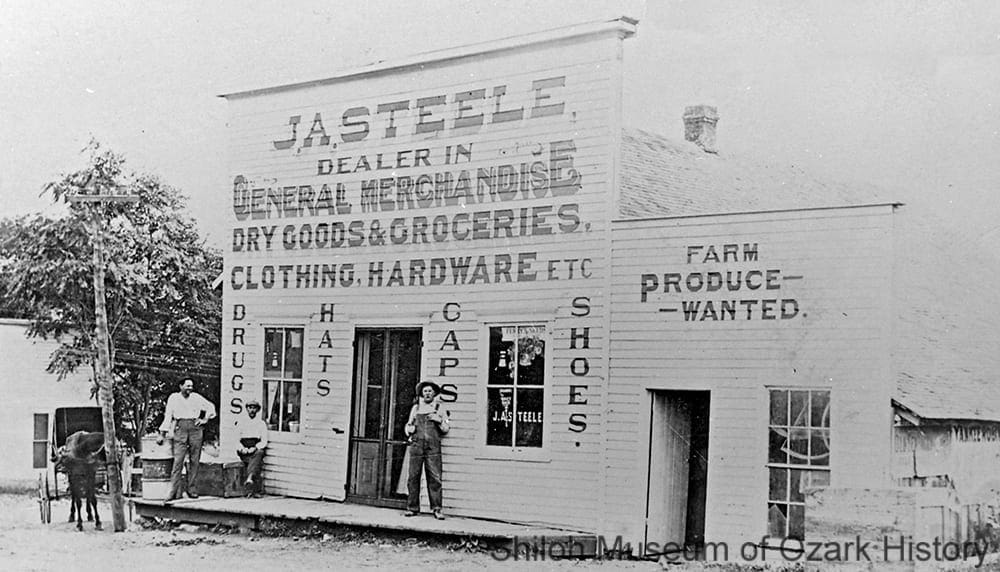
Joseph Albert Steele (1866–1931), a lifelong resident of Elm Springs (Benton County), was a storekeeper and buyer and seller of local farm products. In the May 6, 1917, issue of the Egg Reporter magazine, Steele noted a downturn in the number of eggs being brought to his store, lamenting,”There is no agitation for increasing the poultry and egg production shown in this section.”

Russell Charlesworth and Frances Reeves Collection (S-87-37-5)

Joseph Albert Steele (1866–1931), a lifelong resident of Elm Springs (Benton County), was a storekeeper and buyer and seller of local farm products. In the May 6, 1917, issue of the Egg Reporter magazine, Steele noted a downturn in the number of eggs being brought to his store, lamenting,”There is no agitation for increasing the poultry and egg production shown in this section.”

Russell Charlesworth and Frances Reeves Collection (S-87-37-5)

Honeywell Pentax Spotmatic SP

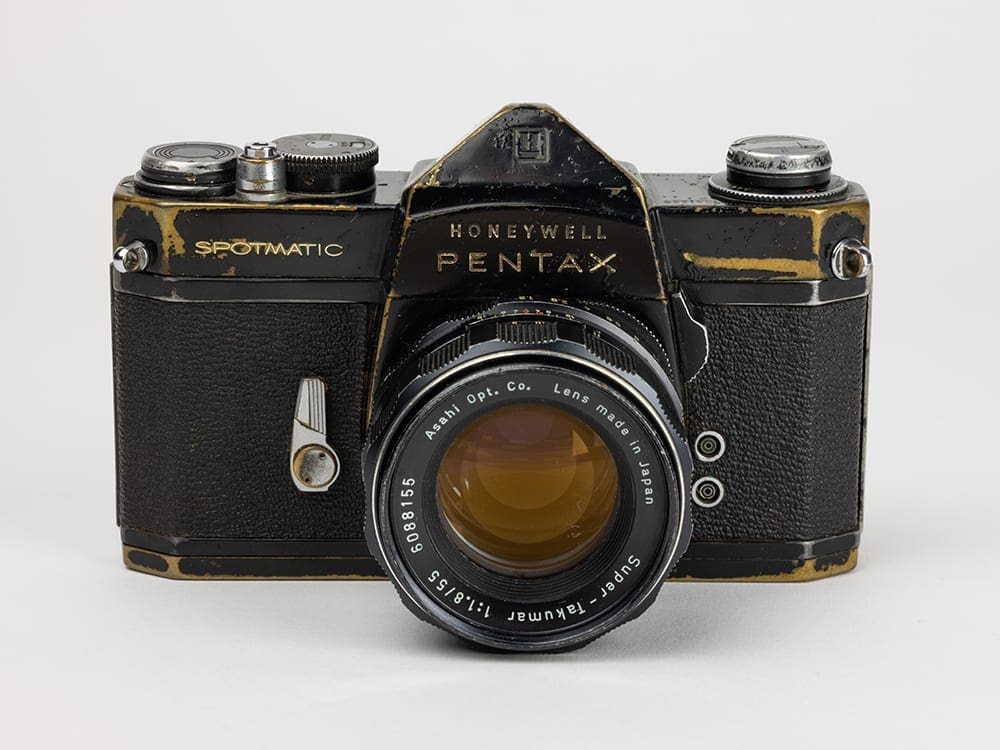
Pentax Spotmatic SP cameraDonated by Mike Donat

This camera saw quite a bit of Northwest Arkansas history. It once belonged to longtime photojournalist Charles Bickford who worked for the Springdale News for almost 40 years. During that time he was one of the best-known photographers in Arkansas. Bickford’s subjects varied from Arkansas football, basketball, and baseball games to politicians speaking from the end of a pickup truck to everyday life events. Many of his photographs and negatives live on in Shiloh Museum’s photo archives as part of the Springdale News Collection.

Later in his career, Charles Bickford sold this Pentax camera to Mike Donat, also a photographer who, amongst a varied career, worked for the Northwest Arkansas Times, shot game and practice footage for the University of Arkansas Athletic Department, worked in Collier Drugstore’s photo department, and in 2006–2007, was the Shiloh Museum’s photographer and darkroom technician. Donat donated this camera, an iconic piece of local photojournalism history, to the Shiloh Museum in 2005.


Bo Williams, the Shiloh Museum’s current photographer/digitization project manager, shares his insight on this Pentax camera:

CAMERA INFO
– Pentax Spotmatic SP in black paint

– Originally released in 1964 but produced until 1976. However, this was likely manufactured pre-1970 due to the lens provided with it (Pentax was not very diligent with correlating their cameras’ serial numbers to specific production dates).
– Manufactured by Asahi Optical Co. in Japan but distributed by Honeywell in the United States

Pentax cameras were, and continue to be, the underdogs of the photographic world. Despite world-renowned quality and innovation, they just never seemed to find the fame that they deserved. Even the Spotmatic SP as seen above was one of the first SLR cameras to include a through-the-lens light meter, a feature that would be considered a given by today’s standards but would have been unheard of sixty years ago. As far as quality is concerned, their lenses are still considered some of the best ever produced, even when compared to contemporary offerings, while many of the camera bodies themselves are still very functional despite being 50+ years old. In fact, I use a Pentax film camera of a similar vintage myself for my own personal work and it has never let me down. Despite all of this, I would imagine that very few readers today will even recognize the Pentax name as they have always lived in the shadow of the likes of the more prevalent Canon and Nikon. This is why, when I was asked to select an artifact from our collection to be highlighted for the Artifact of the Month, I knew immediately what had to be done.

Now for a bit of camera history. Back in the day, photojournalists, press photographers, and war photographers often found themselves in precarious situations while being paid very little to do so. At the same time, budding camera manufacturers such as Pentax usually produced their cameras in two finishes; the cheaper, less durable and inherently more subtle black paint and the now infamous hallmark of any “vintage” camera, silver chrome. The aforementioned working photographers, needing to keep a low profile and some cash in their pockets to buy more film, tended to opt for the cheaper and stealthier black-paint cameras. This was all well and good for a while but then something interesting happened. These photographers found themselves at the precipice of history, quite fortuitously, with a camera in their hand. Their work went on to capture and define world history. The more notoriety the photographers gained, the more attention their cameras received. They became the rock stars of the photographic world and their cameras the equivalent of Fenders and Gibsons. These cameras that were once produced as a cost-saving measure have survived through history to become some of the most sought after and collectible pieces of photographic equipment today. A black-paint camera alone is enough to draw the eye of any photographer, but one worn down to the brass like this humble Japanese Pentax SP, proudly brandishing dents and scratches as testaments to surviving through history, is certainly worthy of attention in 2020. It might be a bit cliché, but the question has to be asked: can you imagine what this camera must have seen?

Pentax Spotmatic SP camera

Donated by Mike Donat

This camera has seen quite a bit of Northwest Arkansas history. It once belonged to longtime photojournalist Charles Bickford who worked for the Springdale News for almost 40 years. During that time he was one of the best-known photographers in Arkansas. Bickford’s subjects varied from Arkansas football, basketball, and baseball games to politicians speaking from the end of a pickup truck to everyday life events. Many of his photographs and negatives live on in Shiloh Museum’s photo archives as part of the Springdale News Collection.

Later in his career, Charles Bickford sold this Pentax camera to Mike Donat, also a photographer who, amongst a varied career, worked for the Northwest Arkansas Times, shot game and practice footage for the University of Arkansas Athletic Department, worked in Collier Drugstore’s photo department, and in 2006–2007, was the Shiloh Museum’s photographer and darkroom technician. Donat donated this camera, an iconic piece of local photojournalism history, to the Shiloh Museum in 2005.


Bo Williams, the Shiloh Museum’s photographer/digitization project manager, shares his insight on this Pentax camera:

CAMERA INFO
– Pentax Spotmatic SP in black paint

– Originally released in 1964 but produced until 1976. However, this was likely manufactured pre-1970 due to the lens provided with it (Pentax was not very diligent with correlating their cameras’ serial numbers to specific production dates).
– Manufactured by Asahi Optical Co. in Japan but distributed by Honeywell in the United States

Pentax cameras were, and continue to be, the underdogs of the photographic world. Despite world-renowned quality and innovation, they just never seemed to find the fame that they deserved. Even the Spotmatic SP as seen above was one of the first SLR cameras to include a through-the-lens light meter, a feature that would be considered a given by today’s standards but would have been unheard of sixty years ago. As far as quality is concerned, their lenses are still considered some of the best ever produced, even when compared to contemporary offerings, while many of the camera bodies themselves are still very functional despite being 50+ years old. In fact, I use a Pentax film camera of a similar vintage myself for my own personal work and it has never let me down. Despite all of this, I would imagine that very few readers today will even recognize the Pentax name as they have always lived in the shadow of the likes of the more prevalent Canon and Nikon. This is why, when I was asked to select an artifact from our collection to be highlighted for the Artifact of the Month, I knew immediately what had to be done.

Now for a bit of camera history. Back in the day, photojournalists, press photographers, and war photographers often found themselves in precarious situations while being paid very little to do so. At the same time, budding camera manufacturers such as Pentax usually produced their cameras in two finishes; the cheaper, less durable and inherently more subtle black paint and the now infamous hallmark of any “vintage” camera, silver chrome. The aforementioned working photographers, needing to keep a low profile and some cash in their pockets to buy more film, tended to opt for the cheaper and stealthier black-paint cameras. This was all well and good for a while but then something interesting happened. These photographers found themselves at the precipice of history, quite fortuitously, with a camera in their hand. Their work went on to capture and define world history. The more notoriety the photographers gained, the more attention their cameras received. They became the rock stars of the photographic world and their cameras the equivalent of Fenders and Gibsons. These cameras that were once produced as a cost-saving measure have survived through history to become some of the most sought after and collectible pieces of photographic equipment today. A black-paint camera alone is enough to draw the eye of any photographer, but one worn down to the brass like this humble Japanese Pentax SP, proudly brandishing dents and scratches as testaments to surviving through history, is certainly worthy of attention in 2020. It might be a bit cliché, but the question has to be asked: can you imagine what this camera must have seen?

Paul’s Blue Ox

Note: Thanks to our museum photographer, Bo Williams, for filming Paul’s Blue Ox in action.

When cataloging an artifact, many aspects of it can be extremely helpful in determining how it was used, where it came from, and the date range of manufacture and/or use. A family history of that artifact can fill in many of those blanks. Artifacts that are stamped with company information, and, in some cases, a patent number, can give us a very specific date range to go from. However, when that patent number does not match a patent resembling the artifact in question, it becomes even more challenging to figure out a date. Such was the case with a recent donation from the Patricia Laird Vaughan estate of “Paul’s Blue Ox,” a toy made by Multipl-aktion Toy Company in Minneapolis, Minnesota.

Paul’s Blue Ox is a “ball-actuated” toy:  marbles roll down the back of the ox until a lumberjack type figure rises up, knocks the marble off of between the ox’s horns, and dumps it on the tray at the bottom of the toy. Paul’s Blue Ox came to us in its original box. Printed on the box is patent number 1791217. A patent search on the internet linked that number to a European patent for female and male connector circuitry, not for a toy from the 1940s (that date was my educated guess).

Next I turned to a web search to find information about the Multipl-aktion Toy Company. The search engine kept trying to tell me the company name was “Multiple-Action” Toy Company, which was not the name I was looking for. I was able to find one web listing for the toy with the same patent number which dated the toy as 1931 but yielded no other new information. I also located an entry in the 1944 Minneapolis city directory for the “Multipl Aktion Toy Company” with salesmen David Ackerberg and Sidney Rivkin listed as company officers.

With nothing to show for my sleuthing but limited bits of information on the Blue Ox, I reluctantly moved on to another artifact from the same donor—a toy xylophone. The xylophone’s patent numbers proved quite helpful, and the numbers started with a “US” prefix. I finished cataloging the xylophone, then, on a whim, I went back to the Blue Ox patents. I decided to try the patent search again, this time adding “US” to the patent number. This led me to a 1929 patent for a liquid-vending machine issued to Sidney L. Long of Minneapolis, Minnesota—same location as the Multipl-aktion Toy Company, but the time period was a bit early and the patent was not for a Blue Ox toy.

I delved deeper into the other patents submitted by Sidney L. Long, and there, finally, I found a ball-actuated toy, patent number 2434571, filed August 29, 1945. That patent is for a toy that looks almost identical to the Blue Ox.

Even though an erroneous patent number led to several dead ends, it still provided valuable information for finally tracking down the correct patent for Paul’s Blue Ox.


Aaron Loehndorf is the Shiloh Museum’s collections and education specialist.

Henbest Sisters

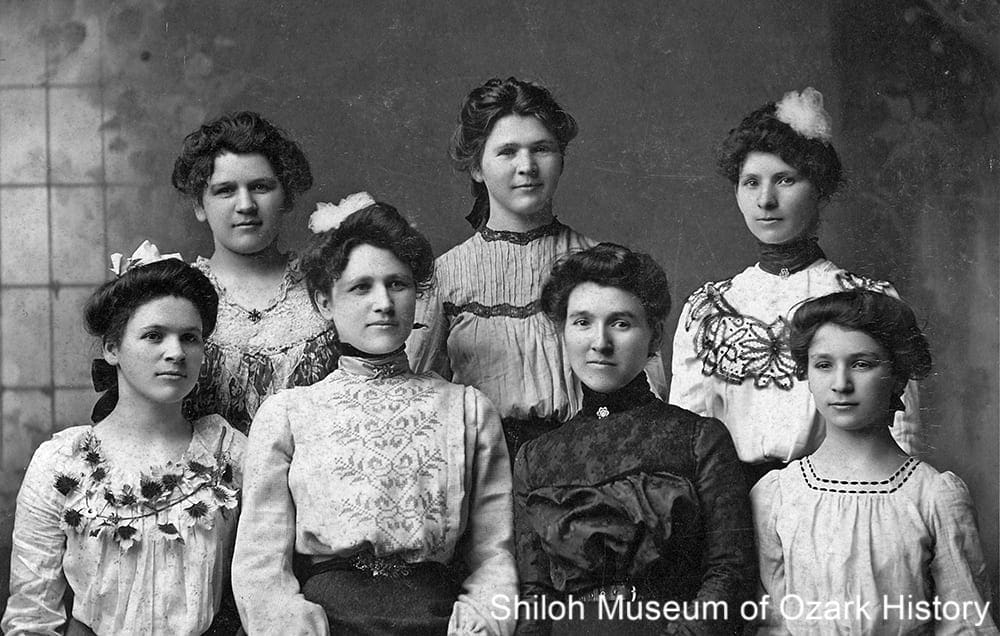
From the 1870s to the 1910s, John Albert and Susan Henbest farmed and raised a family in the Washington County community of Mount Comfort. John and Susan were the parents of fourteen children; ten lived to adulthood. Seven Henbest daughters posed for this portrait around the year 1900. Back row, from left: Zoe, Lottie, Kate. Front row, from left: Margaret, Rosetta, Roxie, Mamie. 

Theda Henbest Dennington Collection (S-93-49-25)

From the 1870s to the 1910s, John Albert and Susan Henbest farmed and raised a family in the Washington County community of Mount Comfort. John and Susan were the parents of fourteen children; ten lived to adulthood. Seven Henbest daughters posed for this portrait around the year 1900. Back row, from left: Zoe, Lottie, Kate. Front row, from left: Margaret, Rosetta, Roxie, Mamie. 

Theda Henbest Dennington Collection (S-93-49-25)

NEWSLETTER