Carpenter’s Slick

Donated by Dr. Stanley Applegate

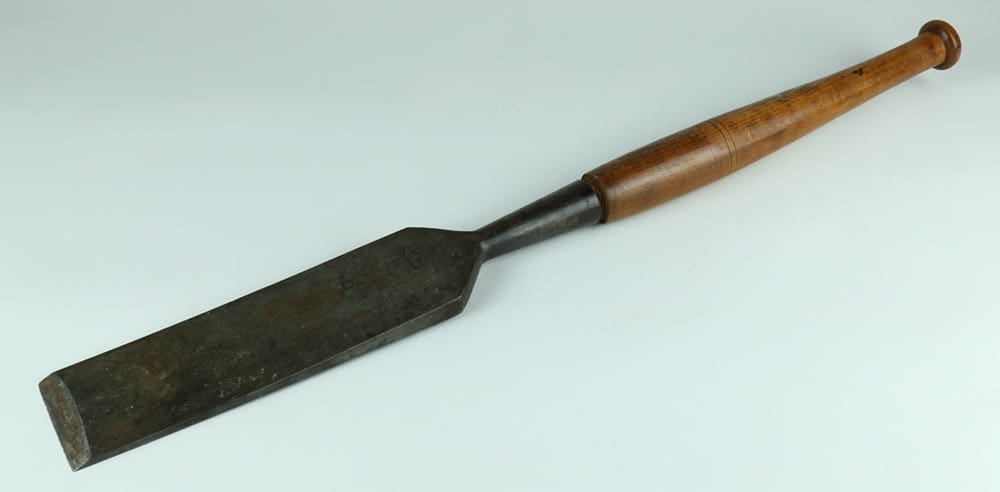
A carpenter’s slick is a type of chisel used with two hands to pare long surfaces of wood following the grain. It was used in timber framing where heavy timber (logs and tree trunks) rather than dimensional lumber (like two-by-fours) was used in construction of buildings.

This Witherby-brand slick comes from the Lockwood Searcy estate. His grandparents came to Northwest Arkansas in the 1850s where they settled on a farm east of Springdale. The family moved into Springdale in the early 1870s. Lockwood (1879-1966) worked as a cooper as a young man, making barrels for the fruit industry that thrived in the area in the early 1900s. In the 1940s he inherited many items from his grandparents, including a box of tools. In later years Lockwood kept a workshop in the back of his garage. The Searcy garage and home are now part of the Shiloh Museum campus.

Thomas H. Witherby, of Milbury, Massachusetts started making fine steel chisels in 1827. The quality of production brought Witherby high regard among tool users. Witherby sold his company to the Winsted Edge Tool Company of Winsted, Connecticut in 1869. Three years later that company decided to drop its line of tools and concentrate on making Witherby chisels. They later added high-quality gouges and drawknives to their product line.

Witherby trademark.

Derby Hat

Donated by Dorothy Morsani

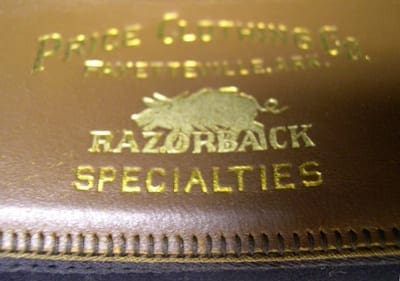
This derby belonged to Memo Morsani of Tontitown (Washington County). The inner lining sports a stamp (below) from Price Clothing Company in Fayetteville.

Richard Dominic “Memo” Morsani (1889-1951) was born in Orvinio, Italy. Memo, his father Emidio, and brother Camillo were among the first families who came with Father Pietro Bandini to settle Tontitown in 1898. Memo was well-known in the region for his beautiful singing voice. After serving with the U. S. Army during World War I, he returned to Tontitown, became a nursery agent in the local fruit industry, and married Rose Bastianelli (another of Tontitown’s founding citizens) in 1926.

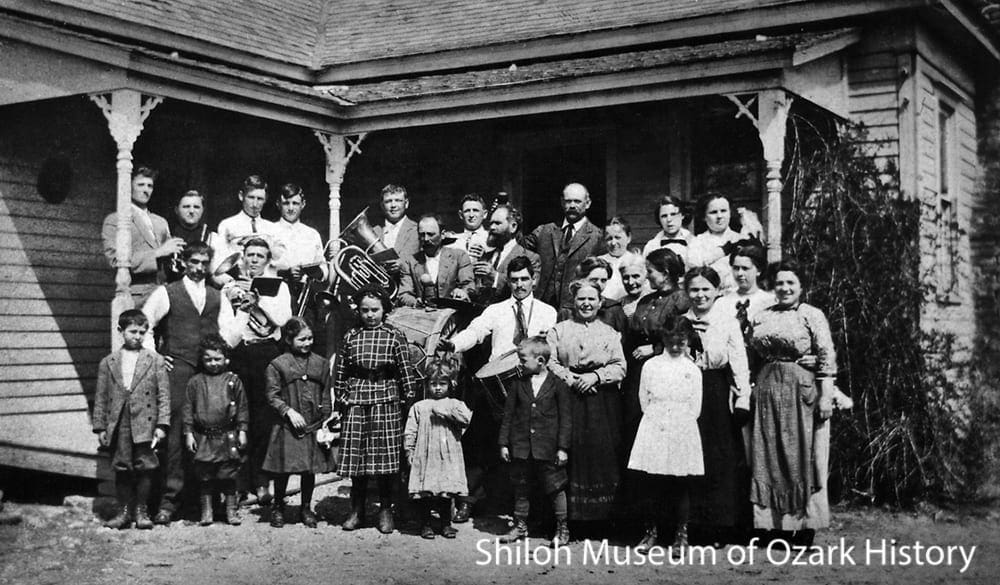
Tontitown get-together, circa 1920. Memo Morsani is on the back row, holding a tuba. Lavinia Zulpo Collection (S-2003-2-1191)

Corduroy Hat

Donated by Hunt’s Department Store

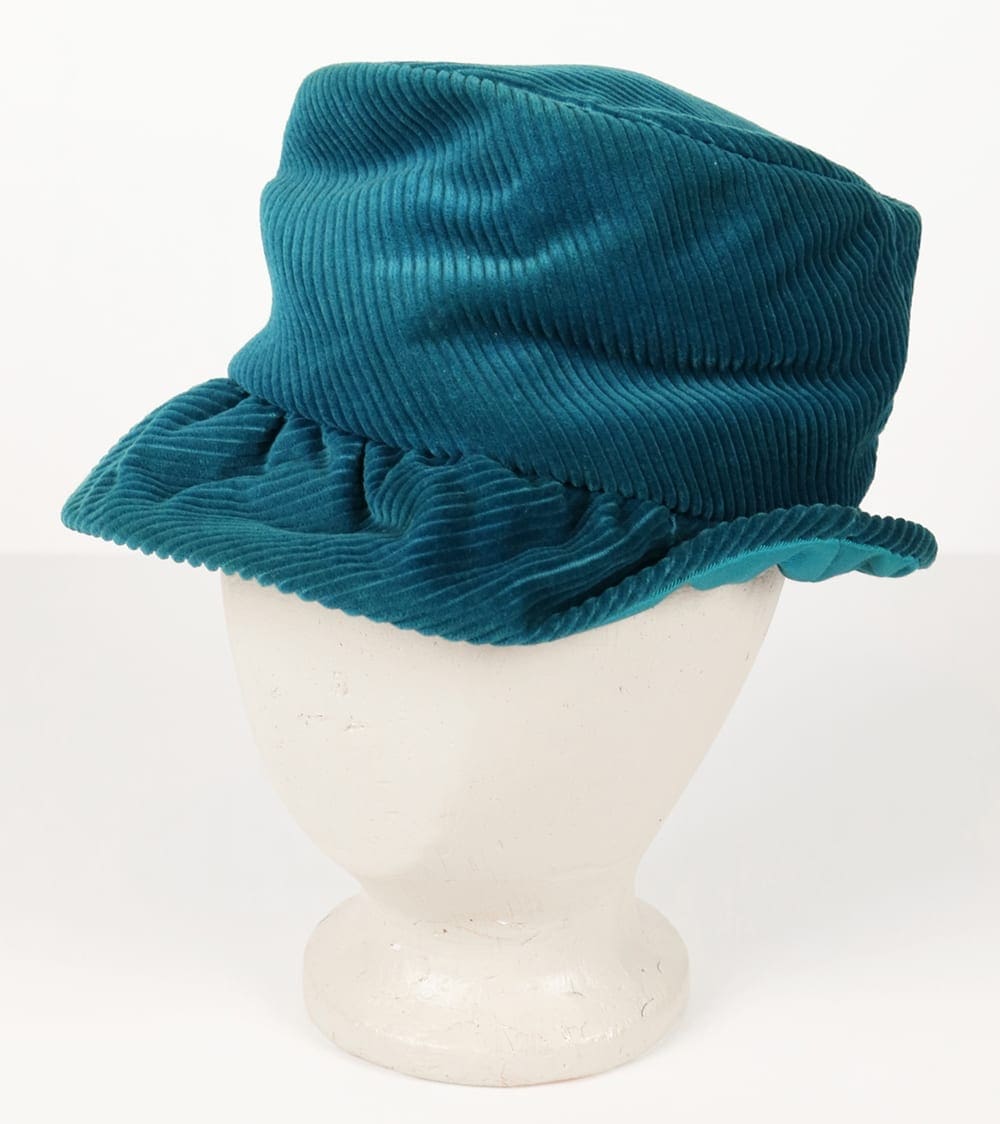
This 1960s bucket-style corduroy hat comes from Hunt’s Department Store.

Fred Hunt established clothing stores in Fayetteville and Rogers in the 1940s, with a Springdale location coming later.

Hunt’s flagship store in Fayetteville expanded in 1964, opening a second location, both on the Fayetteville Square. Hunt’s on the north side of the square specialized in clothing for women and children, while Hunt’s on the east side of the square focused on men’s clothing.

By 1980, Fred Hunt had retired from the retail business. He died in 1995.

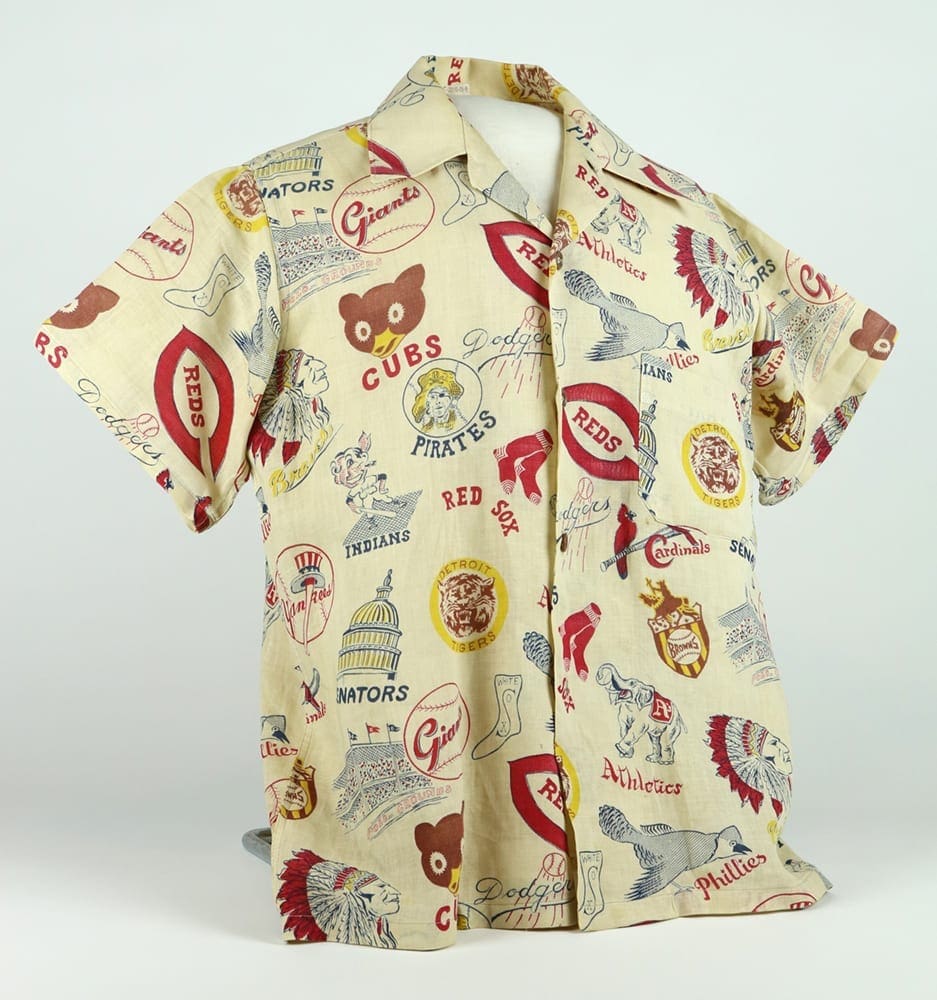
Baseball Mascot Shirt

Donated by Susan and Orville Hall Jr. 

Growing up in Fayetteville in the 1930s and 1940s, Orville Hall Jr. was surely the envy of all his buddies when he wore this snazzy shirt emblazoned with professional baseball team mascots of the day. Several teams on the shirt no longer exist. The St. Louis Browns became the Baltimore Orioles in 1954. The Washington Senators moved to Minnesota in 1961 to become the Twins. The New York Giants remained in New York until 1957 when they and the Brooklyn Dodgers moved to San Francisco and Los Angeles, California.

Brisé Folding Fan

Donated by Ann Sims Ingrum

In the late 1800s and early 1900s folding fans were popular accessories for women. Retail ads called them “a warm-weather necessity.” Brisé is French for “broken,” which refers to the fan blades that overlap and are held together with a ribbon attached to each blade tip and a rivet at the base.

This fan is made of celluloid plastic. In the early 1900s the price of a celluloid fan ran anywhere from twenty-five cents to five dollars, depending on fan’s quality and decorative elements. While many fans at that time were imported to the U. S. from Japan, China, and Europe, there was also a stateside celluloid fan industry which centered in Massachusetts. The 1914 Statistics of Labor report for Massachusetts shows that of the 96 people who worked at home in the manufacture of celluloid novelties, 25% were children under the age of 14. The publication points out that children between the ages of 5 and 14 have “nimble fingers [which] make quick work of running ribbon in fans. . .”

The fan-making process and rates of pay are also included in the 1914 report:
1914 Massachusetts Labor Statistics Report for Celluloid Novelties

Spring Arrivals

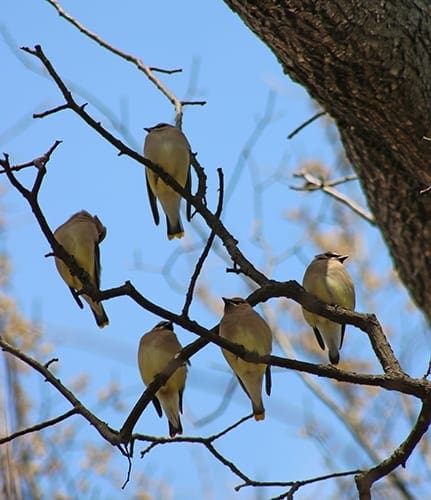
Cedar waxwings at Shiloh Museum.

Cedar waxwings are a sure sign of spring on the museum grounds. Photo by Aaron Loehndorf

There are many signs to the coming of spring. Here at Shiloh it is usually the appearance of spring flowers, ground bees buzzing, and wildlife returning, both human and non. One of the sure signs that happen each year around this time for several days is the appearance of cedar waxwings. These playful birds often travel in large groups. Here at the museum, one or two waxwings arrive first and are followed shortly by larger numbers. In the springtime, they pick at the blossoms of our hackberry trees; in the fall, they will return for a feast of holly berries.

Cedar waxwings at the Shiloh Museum

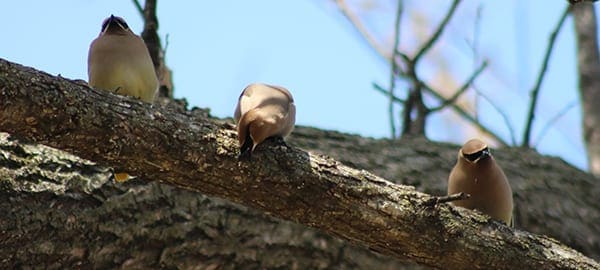
Three ninjas. Photo by Aaron Loehndorf

These “ninjas,” as one staff member called them, silently appear and make their presence known with their calls. Cedar waxwings have two calls. One is a high-pitched, trilled “bzeee” and the other a sighing whistle. Visit Cornell’s Lab of Ornithology for audio clips of each call.

Leucistic robin at the Shiloh Museum

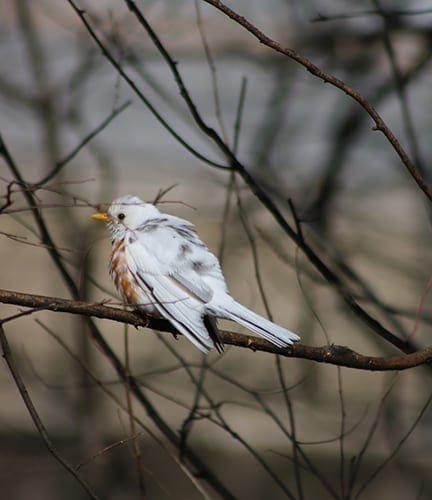
A leucistic robin takes refuge on the museum grounds. Photo by Aaron Loehndorf

Another wildlife sign of spring is the occasional glimpse of a leucistic American robin. Leucism is from the German leucimus, which is from the Greek leukόs for “clear, white.” It is caused by reduced pigmentation which causes pale color or patches of reduced coloring. Unlike albinism which is caused by a lack of melanin, leucism inhibits melanin and other pigments as well.

Adjacent to Spring Creek and right on the Razorback Regional Greenway, our museum campus is a great spot for a nature walk. Bring the family, but please remember to respect the flora and fauna that call this little downtown oasis home.

Aaron Loehndorf is the Shiloh Museum’s collections and education specialist.


Priscilla, Queen of the Vacuum

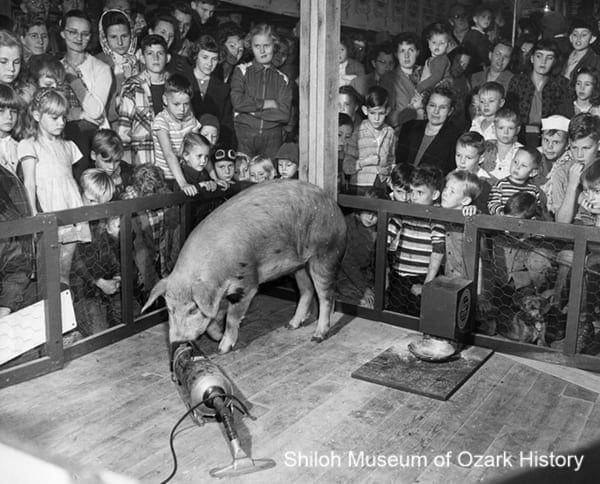
Priscilla the Fastidious Pig, probably at a Quality Feed Store in Springdale, Rogers, or Huntsville, Arkansas, circa 1950.

Priscilla the Fastidious Pig, probably at a Quality Feed Store in Springdale, Rogers, or Huntsville, circa 1950. LeAnn Ritter Underwood Collection (S-2012-31-74)

It’s always fun to look through photo donations because you never know what you’ll find—and learn. In looking through a batch of images donated by LeAnn Ritter Underwood I came across a photo which made me laugh out loud. A pig nosing a vacuum cleaner!

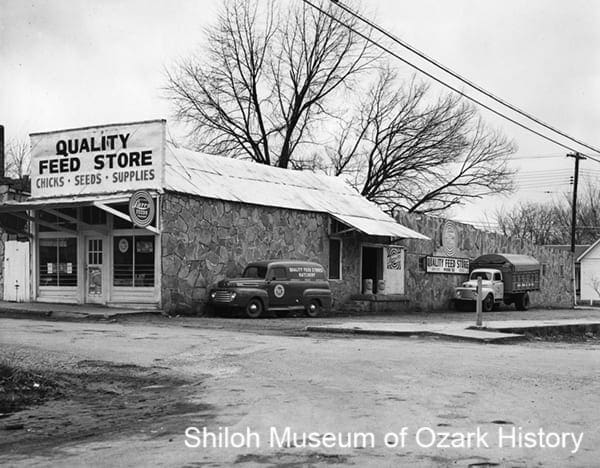
Quality Feed Store, Springdale, Rogers, or Huntsville, Arkansas, 1950s.

Quality Feed Store, Springdale, Rogers, or Huntsville, 1950s. Hubert L. Musteen, photographer. LeAnn Ritter Underwood Collection (S-2012-31-61)

The collection belonged to Mrs. Underwood’s father, Roy C. Ritter (1908-2001), who was born in the Wheeler community of Washington County. Ritter began raising turkeys and broilers in Springdale in the 1930s, just as the poultry industry was getting started in Northwest Arkansas. The broilers raised at his Arkansas Quality Farm were served at his A. Q. Chicken House restaurant, founded in 1947. He also opened Quality Feed stores and hatcheries in Springdale, Rogers, and Harrison. Ritter was a leader in the poultry industry, both statewide and nationally, serving as president of such organizations as the Arkansas Poultry Federation, the National Turkey Federation, and the National Broiler Council. Ritter was also a community leader, serving as Springdale mayor in the 1970s.

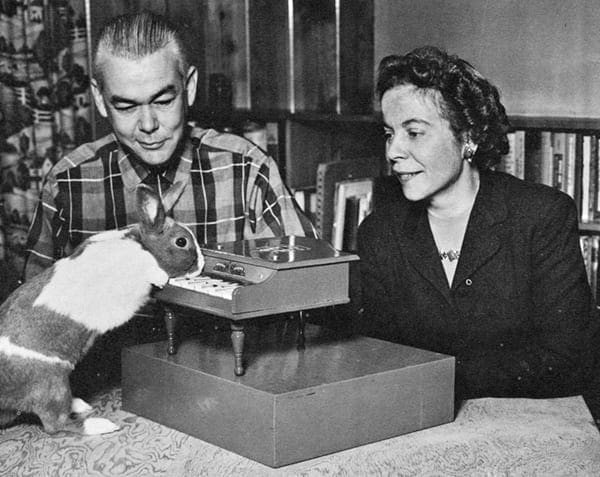
So why the pig photo? It took a few Google searches before I came across a reference in C. James Goodwin’s 1999 book, A History of Modern Psychology. In it he wrote about the work of Keller and Marian Breland, who, as graduate students during World War II, worked with noted psychologist B.F. Skinner to train pigeons to guide missiles.  After graduate school the Brelands opened Applied Behavior Enterprises in Minnesota, training animals for entertainment and commercial purposes. Their first contract was with General Mills, teaching hens to tap dance as a way to advertise the company’s Larro Farm Feed.

Animal trainers Keller and Marian Breland, from the booklet Animal Wonderland: The Story of the Keller Breland Educated Animals, 1962.

Animal trainers Keller and Marian Breland, from the booklet Animal Wonderland: The Story of the Keller Breland Educated Animals, 1962. Ernie Deane Collection (“Hot Springs IQ Zoo”), Manuscript #167, S-2012-136-63)

Their success led to “Priscilla the Fastidious Pig.” According to an article about the Breland’s training methods, not only could Priscilla push a vacuum, she could turn on the radio, put clothes in a hamper, eat breakfast at a table, answer quiz questions, and select her favorite food—Larro, of course—from that of competitors. From 1948 to 1950 Priscilla performed her act at feed-stores, county fairs, and on television. Except it wasn’t the same Priscilla. Every few months, as Priscilla grew in size, she was replaced by a new trained pig, one that was smaller and easier to ship.

Comparison of the stage and fencing in the Ritter photo with similar photos on the Internet help ID this pig as Priscilla, along with the feed box with its Larro decal. A notation on the back of the photo reads, “Frame and send to Quality Springdale,” suggesting that the photo might have been taken by a Larro representative at one of Ritter’s Quality Feed stores.

There’s another Arkansas connection to this story, as I discovered by looking in newspaperman Ernie Deane’s extensive research files, donated to the Shiloh Museum by his daughter Fran Deane Alexander. In the early 1950s the Brelands moved their company to Hot Springs and opened the I. Q. Zoo in 1955. Visitors could watch such animal acts as piano-playing cats, drumming ducks, high-wire hens, and basketball-dunking raccoons. The critters were trained through “operant conditioning,” a type of animal psychology which encouraged specific, desirable behaviors with food rewards.

So as a result of one funny photo I learned about Priscilla, the Brelands, and I. Q. Zoo. Who knew?

Marie Demeroukas is the Shiloh Museum’s photo archivist/research librarian.


A Thorny Thicket

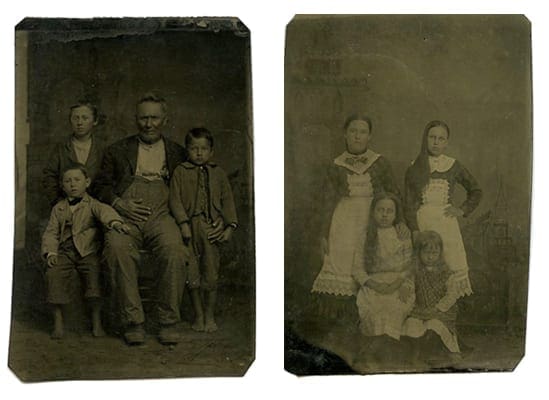
Tintypes recently discovered in the Ada Lee Shook Collection.

Last year I was deep in the process of cataloging the Ada Lee Smith Shook (1928-2009) Collection. Ada Lee’s ancestors were among the first to settle in Northwest Arkansas. I worked up a very basic family tree, found spouses, divorces, deaths of loved ones, births, graduations, lifelong friendships, and all the usual highs and lows found in a lifetime. I became so attached to her and her family, it was sad to watch them age very quickly through the thousands of photographs. In this case, I did not have the luxury of watching it occur in real time, but over the course of a few months.

When I completed this project, glutton for punishment that I am, I accepted the challenge of going through three more collections donated to us by Ada Lee in the years leading up to her death. We found a treasure trove of photos loaned for our History of Washington County (published by the Shiloh Museum in 1989). Many are original photographs and there is also a lovely set of tintypes.

With this batch of photos, I have now been introduced to a whole new branch of Ada Lee’s family tree. But a mystery began with two tintypes slid between mountains of photos in envelopes and boxes.

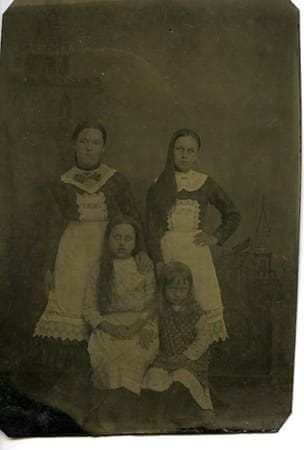
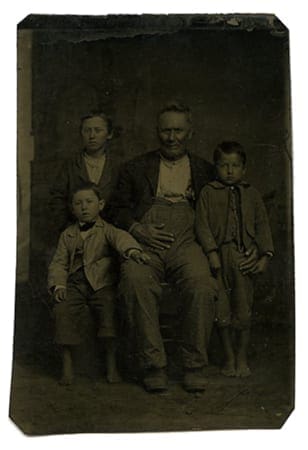
The tintype on the left was familiar, as we have a copy of the image in our photo collection. It is George Washington Vaughan (1813-1888) with his grandsons. We knew the name of only one grandson in the picture—Albert W. Bevers—who was reported to be the boy on the right. The second tintype, showing four unidentified girls, appears to have been taken on the same day as the Vaughan tintype.

George Washington Vaughan and grandsons

A copied photo of George Washington Vaughan and grandsons from our museum collection—the same image as the newly-discovered tintype. Ada Lee Shook Collection (S-85-323-31)

The rapture of discovery was put on hold while I worked up a more intensive family tree in a tentative hope we could come up with IDs for the girls in the second tintype and perhaps the boys with George Washington Vaughan.

Based upon clothing and an age estimate for Albert W. Bevers, the previously cataloged photo had an estimated age of early 1880s attached to it. Keeping that in mind, we checked the dates for all of George Washington Vaughan’s grandchildren and compared those against the estimated date of the image and the guesstimated age of the children in the images. And let me tell you—when historians do math, it is a hoot!

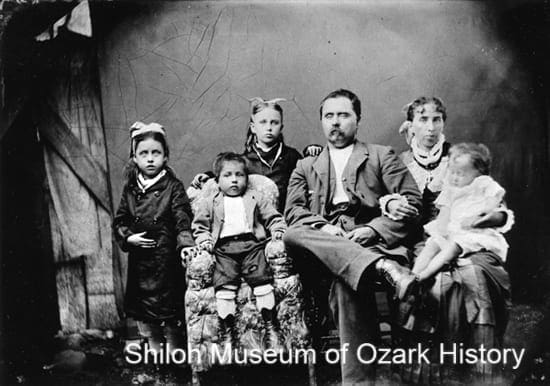
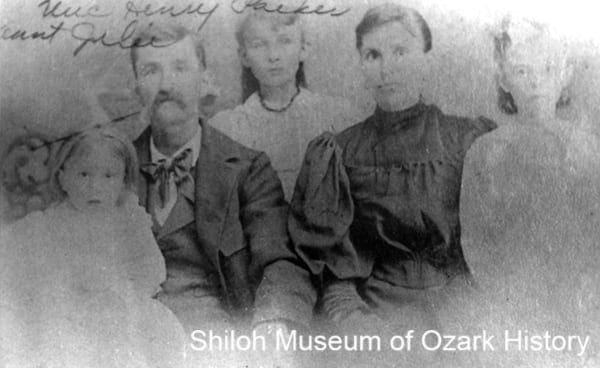
I located other photos of the families involved (see two below) and we began the process of elimination.

Joseph Bevers and Ada Vaughan Bevers family of Hindsville, Arkansas, circa 1880.

Joseph Bevers and Ada Vaughan Bevers family of Hindsville, Arkansas, circa 1880. From left: Cora, Albert, Amy, Joseph, and Ada holding Ada Estelle. Ada was the daughter of George Washington Vaughan. Ada Lee Shook Collection (S-87-325-14)

Henry Parker and Julia Fitch Parker Family. circa 1890s.

Henry Parker and Julia Fitch Parker Family. circa 1890s. Julia was the granddaughter of George Washington Vaughan. Ruby Vaughan Collection (S-96-1-340)

After studying photos and birthdates of George Washington Vaughan’s grandchildren, we postulated that the children in the tintypes were those of two daughters of George Washington Vaughan—Margarett Louisa Vaughan Fitch (1838-1926) and Ada Ann Isabelle Vaughan Bevers (1851-1943). While there are several grandsons that could possibly be the other two boys in the George Washington Vaughan and Albert Bevers tintype, we think the children came from the Bevers and Fitch families and were not a hodgepodge of children belonging to the siblings of Margarett Vaughan Fitch and Ada Vaughan Bevers.

Granddaughters of George Washington Vaughan

We now believe these are the granddaughters of George Washington Vaughan.

So who do we think the children in the tintypes are?  For the girls, we suggest, front row, L-R:  Cora Bevers Southerland (1874-1902), Ada Estelle Bevers Slaughter (1879-1955). Back row, L-R: Julia Ann Fitch Parker (1868-1946), Amy Elizabeth Bevers Southerland (1872-1907)

George Washington Vaughan and grandsons

George Washington Vaughan and grandsons.

As for the boys, we believe they are, front row, L-R: Lemuel Washington Fitch (b. 1876), George Washington Vaughan, and Albert W. Bevers (1877-1964). Standing in back is William Byron Fitch (1874-1893).  I was able to locate an image of another grandson, Catlett Franklin Fitch (1871-1948), but am almost certain he is not pictured, although it is possible.

I feel sure about the identifications of Albert and Ada, because in the course of cataloging this collection I watched them grow from children into elderly adults. The other children I can only speculate on. Until someone brings in a photo with IDs, we will never know for certain who they are.

Moral of the story: ID your photos early, in detail, and while you still remember. Do not assume that decades later your children, grandchildren, or great-grandchildren will know who these people are.

Rachel Whitaker is the Shiloh Museum’s research specialist.


Plowing New Ground

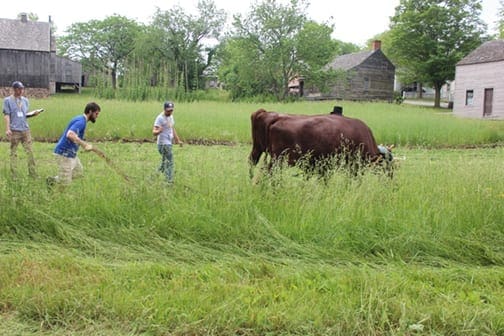
Aaron behind the plow. Photo by Judy Costello

Professional development opportunities and conferences are opportunities to not only network with colleagues from across the country, but in some cases around the world. Recently education manager Judy Costello and I were fortunate to be able to travel to Mumford, New York, for the Association for Living History, Farm and Agricultural Museums (ALHFAM) annual conference. This year’s conference theme was “Breaking Through Barriers: Living History in Modern Times.”

Like many other conferences, there were sessions about the work of different museums and historic sites as well as the opportunity to visit several sites in the area. But there are a couple of traditions that are unique to ALHFAM conferences. One such tradition is the Plowing Match, where conference attendees can sign up to plow a furrow. This year at Genesee Country Village & Museum the competition involved directing a team of oxen.

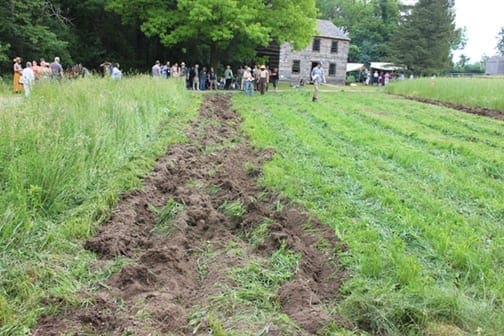
The finished furrow. Pretty good for a beginner! Photo by Judy Costello

There were three categories offered in the contest: novice, apprentice, and expert. Since I have never plowed before, I signed up as a novice. Matt Sanbury of Genesee Country Village & Museum walked alongside us novices as we plowed, giving  tips about which way to lean the plow as we guided the oxen team.

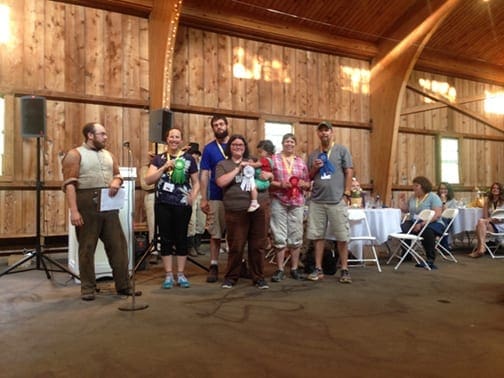
In the end there were over forty people who took the plowing challenge, including twenty-six novices. It was quite a surprise during the closing banquet when I was awarded third place in the novice category and was given a commemorative mug made by Mark Presher, master potter at Genesee.

The top five in the novice class. Photo by Judy Costello

While I do not expect to be plowing anytime soon here at Shiloh, being able to participate in historic trades like plowing allows us to convey what people in the Ozarks historically had to deal with on a daily basis.

Aaron Loehndorf is the Shiloh Museum’s collections and education specialist.


Chasing Wild Geese

My curiosity has been piqued lately. Want to chase a few wild geese with me?
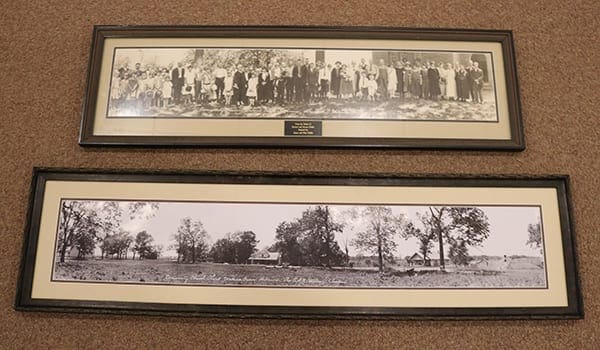
J. C. Hawkins’ 1925 panoramic photos recently brought in by Rev. John E. King on behalf of the Administrative Commission for Walnut Grove Presbyterian Church.

J. C. Hawkins’ 1925 panoramic photos recently brought in by Rev. John E. King on behalf of the Administrative Commission for Walnut Grove Presbyterian Church.

Wild Goose #1. Rev. John E. King brought in two wonderful panoramic photos of a church and congregation on behalf of the Administrative Commission for Walnut Grove Presbyterian Church (near the Washington County town of Farmington). Sadly, the church recently disbanded. The images were taken in 1925 by J.C. Hawkins of Newton, Iowa. Hawkins’ name seemed familiar so I checked our photo database. Sure enough, we now have ten of his panoramic images in the collection, all taken in Washington and Madison counties within the span of a few weeks:

  • April 22—Fayetteville High School students
  • April 22—Fayetteville Public School eighth-grade students
  • April 24—Washington School students (Fayetteville)
  • May 3—Walnut Grove Presbyterian Church congregants and environs (near Farmington)
  • May 4—Westside School students (Fayetteville)
  • May 11—Sligo Wagon Wood Factory workers (Fayetteville)
  • May 29—Aftermath of the fire on the Huntsville square
  • May 30—Decoration Day participants (Witter)
  • May 31—Church congregants at Jones School (near Wharton)

Who was John C. Hawkins? Through an Internet search I learned that in 1909 he founded the Clipless Paper Fastener Company in Newton. While he’s listed as a manufacturer of paper fasteners in the 1920 census, by 1930 he’s a hotel manager. The executive director of the Jasper County Historical Museum in Newton kindly sent a scan from A Century of Industrial Progress in Newton, Iowa, which notes that Hawkins’ company went into receivership and was purchased in 1925. So perhaps he picked up a camera as a way to earn a bit of money. Neither the director nor a county historian knew of Hawkins’ photographic activities, but now they’re intrigued as well. Perhaps they’ll chase that wild goose for me.
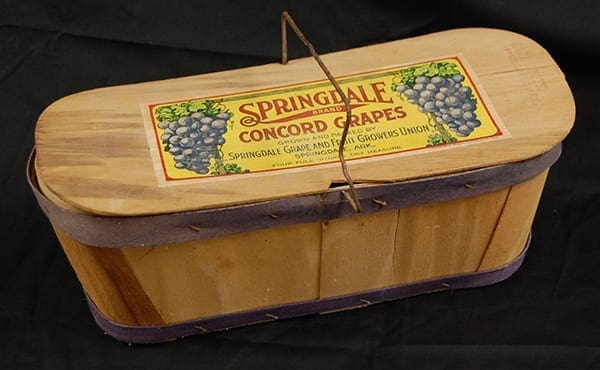
Grape basket, 1920s.

Grape basket, 1920s. Shiloh Museum purchase (S-2012-114)

Wild Goose #2. A researcher working on a project about the grape industry in Springdale needed two things from me—a scan of a label found on a grape basket in the collection and information about the Ozark Grape Festivals of the 1920s. As part of my research I read that during the first festival in 1925 the Springdale Community Club sent out nearly 4,000 complimentary baskets of grapes “to practically every State in the Union and to Canada.”

According to an article in the April 29, 1937, edition of the Springdale News, “The baskets provided for mailing were filled with choice Concords and bore the label of the grape associations. . . .” Even more grape baskets were sent in 1926. So I got to thinking, what if our grape basket is one of the festival baskets? The label from the Springdale Grape and Fruit Growers Union has a 1920s vibe about it. Most of the grapes grown in the Springdale area were sent by truck or rail to the Welch Grape Juice plant in bushel baskets or crates. The history of this basket will remain a mystery until a grape festival basket with its shipping label appears one day or we find an image showing the baskets prepared for mailing.
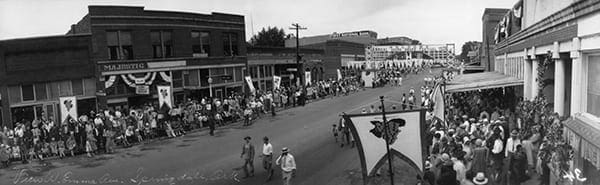
Ozark Grape Festival, Emma Avenue (Springdale), August 1926.

Ozark Grape Festival, Emma Avenue (Springdale), August 1926. Gene Thompson Collection (S-96-56-5)

Wild Goose #3. According to the 1937 article, during the 1926 grape festival “Special containers of grapes were sent to President Coolidge and to Premier Mussolini. The containers were small refrigerators consisting of veneered pine boxes 24 inches square, inside of which were copper containers holding eight four-quart baskets of grapes with a net weight of five pounds each. Ice was packed around the copper container to preserve the grapes.”

Curious to know if there was a record of the president receiving this gift, I contacted the Calvin Coolidge Presidential Library and Museum in Massachusetts. The archivist there graciously checked the photos and scrapbooks in their collection, but nothing turned up. A check with a manuscript reference librarian at the Library of Congress, which has a Coolidge Papers collection, was also negative as Coolidge destroyed most of his personal papers before his death. I think the fate of the grape box and the president’s thoughts about it will remain mysteries. But there’s no mystery as to why a box was sent to Premier Mussolini of Italy. The Italian immigrant community of Tontitown supplied tons of grapes to the Welch plant over the years.
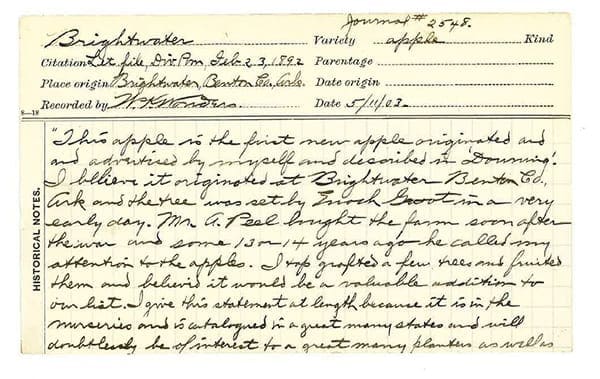
“Brightwater” apple history card, created in 1903 and featuring an excerpt from George F. Kennan’s 1892 letter.

“Brightwater” apple history card, created in 1903 and featuring an excerpt from George F. Kennan’s 1892 letter. Courtesy USDA Fruit Laboratory Card Catalog Collection (MS 365). Special Collections, USDA National Agricultural Library

Wild Goose #4. When I attended a recent event at Brightwater, Northwest Arkansas Community College’s new culinary school in Bentonville, I heard one of the staff members say that the apple for which the school is named is extinct. Curious to learn more, I contacted Guy Ames of Ames Orchard & Nursery in Fayetteville. Guy’s a passionate plantsman who’s been growing fruits and fruit plants adapted to Ozark conditions since 1983, including several Arkansas heirloom apples. He put me in touch with Scott Gothard in Amorel (Mississippi County). Equally passionate, Scott’s hobby is collecting and growing every Arkansas apple he can find. Both men searched their reference books and contacted friends in the field in an effort to find Brightwater.

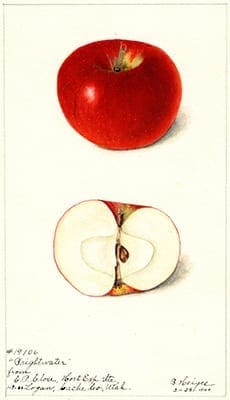
I also heard from Sara Lee, archivist at the National Agricultural Library (NAL) in Maryland. She generously spent quite a bit of time digging for Brightwater info in NAL’s early fruit books and records. Her efforts turned up several interesting tidbits, including the June 1884 edition of  Gardener’s Monthly and Horticulturalist which included a note from J.B.G. [probably nurseryman John B. Gill] of Springdale, who had mailed two apples to the periodical for review. The editor pronounced Brightwater as “excellent” and a “very desirable apple for that far down section of the country.”

Artist Bertha Heiges’ depiction of a Brightwater apple from Logan, Utah, 1900.

Artist Bertha Heiges’ depiction of a Brightwater apple from Logan, Utah, 1900. Courtesy USDA Pomological Watercolor Collection

Sara also sent a scan of an index card with an excerpt from an 1892 letter by George F. Kennan of Rogers. Kennan is said to have established the first nursery in the area. He grew and promoted Brightwater. He writes, “I believe [the apple] originated at Brightwater Benton Co., Ark and the tree was set by Enoch Groot [Trott, the first settler of Brightwater] in a very early day. Mr. A. [Albert] Peel bought the farm soon after the [Civil] war and some 13 or 14 years ago he called my attention to the apple. I top grafted a few trees and fruited them and believed it would be a valuable addition to our list. I give this statement at length because it is in the nurseries and is cataloged in a great many states and will doubtlessly be of interest to a great many planters as well as nursery men.”

At this point finding Brightwater, if it’s still out there, will take a concentrated effort from apple hunters who know what they’re looking for, heirloom growers throughout the nation who may have Brightwater in their collection, and contact with folks in Brightwater and nearby Avoca who perhaps have old apple trees growing on their property. A daunting task but I take heart with what Scott wrote: “If we can find it, we can save it.”

So, four questions, zero answers. That’s the problem with a wild goose chase—sometimes you run into a dead-end or the search is greater than what you have time for. But the interesting bits of history that you learn and the generous, helpful people you meet along the way sure are fun. My grateful thanks to everyone who took the time to answer my questions.

There are a number of marvelous turn-of-the-20th-century images of Arkansas fruit in the USDA Pomological Watercolor Collection. The National Agricultural Library is in the process of digitizing their American catalogs in the Henry G. Gilbert Nursery and Seed Trade Catalog Collection.  As of February 2017 they had over 26,000 catalogs digitized!

Marie Demeroukas is the Shiloh Museum’s photo archivist and research librarian.



NEWSLETTER