Fireplace Tool

Donated by Mary Kwas

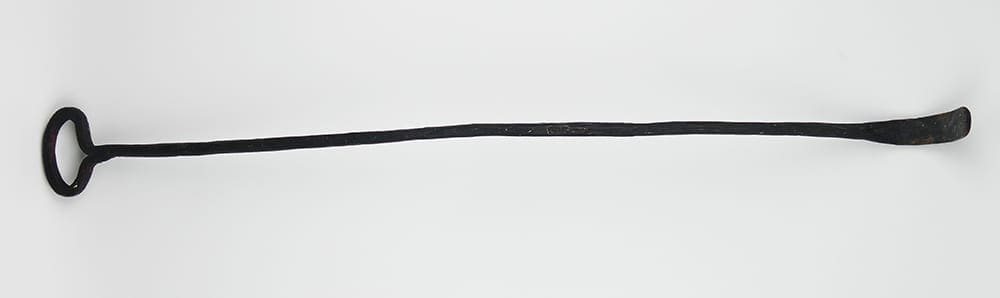
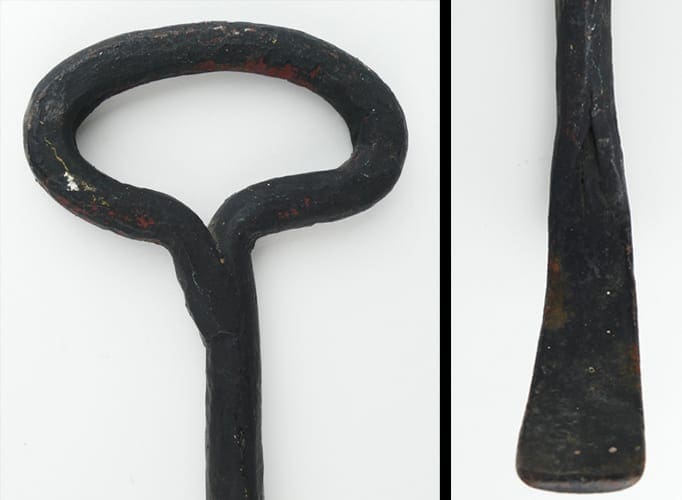
Gaines Tucker and his wife, Estelle “Essie” Dill West Tucker, used this handmade fireplace poker at their home in the Dean community near Metalton (Carroll County). After Gaines Tucker lost his job during the Great Depression, the Tuckers moved to the Ozarks from North Carolina in the early 1930s. They bought an old cabin on ten acres in Carroll County, where Gaines farmed and Essie ran a second-hand clothing shop out of their home to help make ends meet. Gaines died in 1940 and Essie stayed on in the cabin until her death in 1951.

Closeup of handle and poker end.

Nick Clemmons

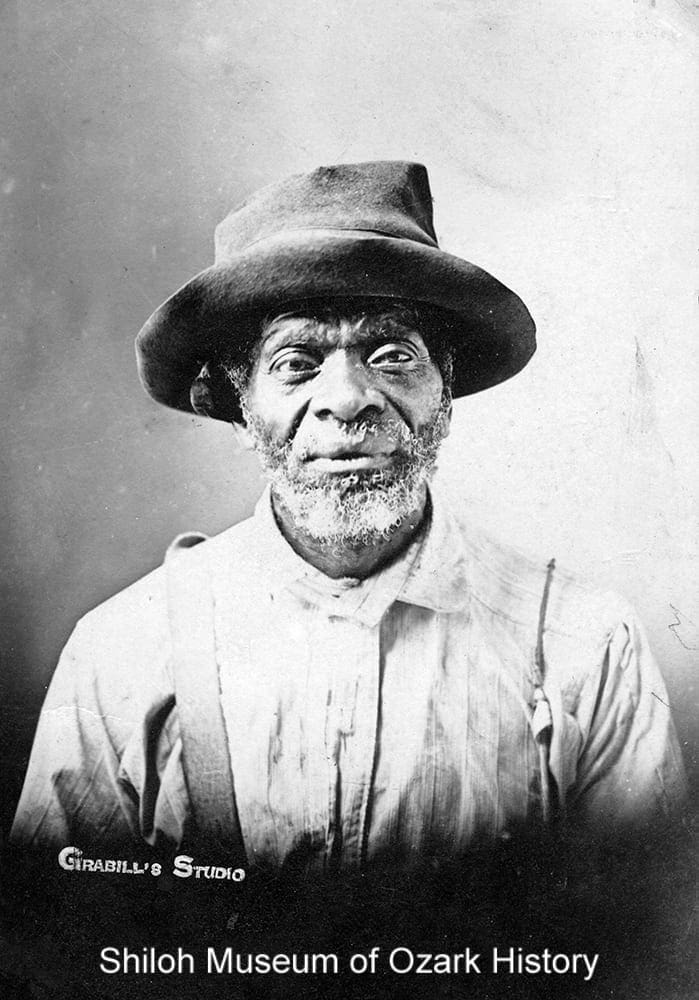
Fayetteville resident Nick Clemmons, circa 1910. We find Clemmons on the 1880 census, a 40-year-old widower living in Fayetteville with nine children and grandchildren. His occupation is listed as “laborer.”
 
Perhaps Nick Clemmons’ wife was Millie Clemmons, a Fayetteville woman listed on the 1880 mortality scheduled as having died of cholera in 1879.
 
The 1900 census shows Clemmons living in Fayetteville with his daughter Rindy and her family.
 
The last time we find Nick Clemmons on the census is in 1910. He is living alone at 235 E. Huntsville Road in Fayetteville, near the present-day intersection of Huntsville Road and Combs Avenue.
 
Burch Grabill, photographer. Washington County Historical Society Collection (P-172)


Nick Clemmons, Fayetteville, Arkansas, circa 1900

Rev. Peter and Martha Carnahan, Bentonville, Arkansas, 1890
Fayetteville resident Nick Clemmons, circa 1910. We find Clemmons on the 1880 census, a 40-year-old widower living in Fayetteville with nine children and grandchildren. His occupation is listed as “laborer.”
 
Perhaps Nick Clemmons’ wife was Millie Clemmons, a Fayetteville woman listed on the 1880 mortality scheduled as having died of cholera in 1879.
 
The 1900 census shows Clemmons living in Fayetteville with his daughter Rindy and her family.
 
The last time we find Nick Clemmons on the census is in 1910. He is living alone at 235 E. Huntsville Road in Fayetteville, near the present-day intersection of Huntsville Road and Combs Avenue.
 
Burch Grabill, photographer. Washington County Historical Society Collection (P-172)


Hardness Tester

Donated by the Ball CorporationRockwell Hardness Tester

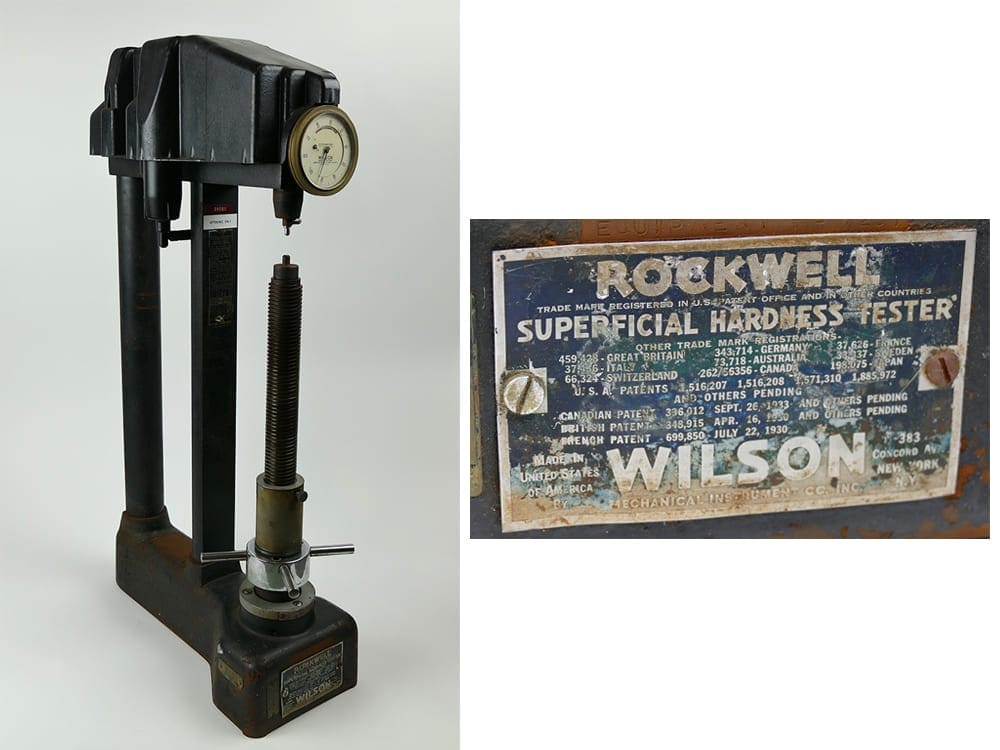
The Rockwell hardness tester was used to determine the strength, or “hardness,” of metal. Hardness was measured by attempting to put a dent into metal with increasing pressure, with the corresponding hardness number indicated on a gauge. The hardness tester seen here used a conical diamond to make the dent. 

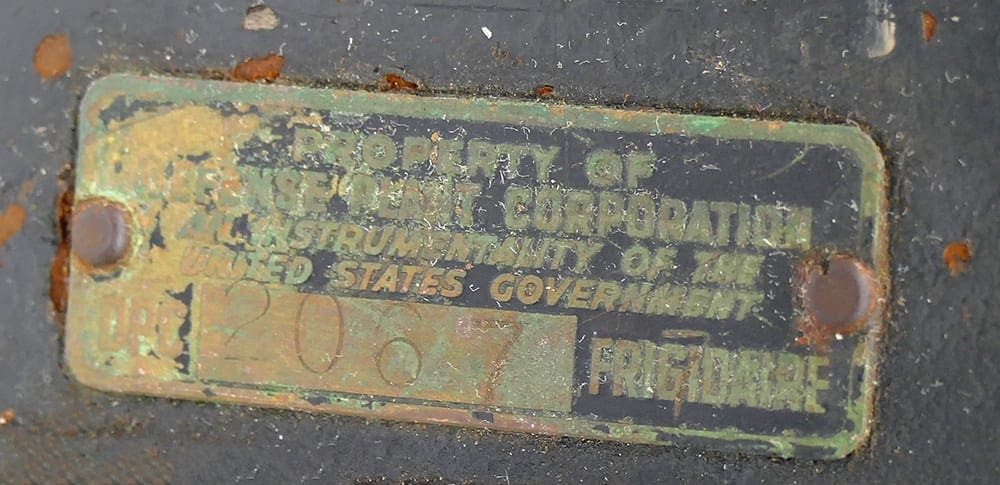
The history behind this particular tester is not completely known. Most recently it served at Heekin Can Company in Springdale. However, the tester has a metal tag identifying it as property of the “Defense Plant Corporation” or DPC. The DPC was created in 1940 to help with the war effort during World War II. Various wartime federal agencies would make a request for manufactured goods and the DPC would make sure that factories were able to deliver. Over six years the DPC distributed over nine billion dollars on 2,300 projects across forty-six states and overseas. Most of that money was spent building and equipping new factories and mills, which were primarily leased to private companies.

The metal tag also has “Frigidaire” engraved on it. Frigidaire Appliance Company made many components during World War II, including propellers, fuel tanks, and machine guns.

Metal tag on hardness tester.

Heekin Can Company was founded in Cincinnati, Ohio, by James Heekin in 1901. Son James J. Heekin took over the business in 1904 following his father’s passing. A second plant was added in 1915, and Heekin went on to become the largest regional manufacturer of metal food containers in the U.S., with  factories in Arkansas, Illinois, Indiana, Ohio, Pennsylvania, Tennessee, West Virginia, and Wisconsin.

In the 1940s, Springdale was the center of Northwest Arkansas’s agricultural and canning industries. Heekin decided to locate a plant in Springdale to provide packing cans for locally processed fruits and vegetables. On June 4, 1949, the grand opening of Springdale’s Heekin Can Company was met with much fanfare, including speeches by Heekin president Daniel Heekin, Frisco Railroad vice president John Payne, and Arkansas highway commissioner Orval Faubus. The Springdale High School Band and Slim Picken’s Famous Western Band provided musical entertainment as some 4,000 visitors toured the new factory. Free soda pop and fried chicken box lunches were provided for all in attendance. 

Heekin remained under family control until 1965 when it was sold to Diamond International to avoid a possible hostile takeover. In 1982 Heekin was sold as an independent company to Wesray Holding Corporation following a hostile takeover of Diamond. Three years later Heekin went public. Ball Corporation acquired Heekin in 1993. Phaseout of operations at the Springdale facility began in 2019, with the final plant closure expected sometime in 2021.

Learn more about Springdale’s Heekin Canning Company and the local canning industry in our Canned Gold online exhibit.

Rockwell Hardness Tester

Donated by the Ball Corporation

The Rockwell hardness tester was used to determine the strength, or “hardness,” of metal. Hardness was measured by attempting to put a dent into metal with increasing pressure, with the corresponding hardness number indicated on a gauge. The hardness tester seen here used a conical diamond to make the dent. 

The history behind this particular tester is not completely known. Most recently it served at Heekin Can Company in Springdale. However, the tester has a metal tag identifying it as property of the “Defense Plant Corporation” or DPC. The DPC was created in 1940 to help with the war effort during World War II. Various wartime federal agencies would make a request for manufactured goods and the DPC would make sure that factories were able to deliver. Over six years the DPC distributed over nine billion dollars on 2,300 projects across forty-six states and overseas. Most of that money was spent building and equipping new factories and mills, which were primarily leased to private companies.

Metal tag on hardness tester.

The metal tag also has “Frigidaire” engraved on it. Frigidaire Appliance Company made many components during World War II, including propellers, fuel tanks, and machine guns.

Heekin Can Company was founded in Cincinnati, Ohio, by James Heekin in 1901. Son James J. Heekin took over the business in 1904 following his father’s passing. A second plant was added in 1915, and Heekin went on to become the largest regional manufacturer of metal food containers in the U.S., with  factories in Arkansas, Illinois, Indiana, Ohio, Pennsylvania, Tennessee, West Virginia, and Wisconsin.

In the 1940s, Springdale was the center of Northwest Arkansas’s agricultural and canning industries. Heekin decided to locate a plant in Springdale to provide packing cans for locally processed fruits and vegetables. On June 4, 1949, the grand opening of Springdale’s Heekin Can Company was met with much fanfare, including speeches by Heekin president Daniel Heekin, Frisco Railroad vice president John Payne, and Arkansas highway commissioner Orval Faubus. The Springdale High School Band and Slim Picken’s Famous Western Band provided musical entertainment as some 4,000 visitors toured the new factory. Free soda pop and fried chicken box lunches were provided for all in attendance. 

Heekin remained under family control until 1965 when it was sold to Diamond International to avoid a possible hostile takeover. In 1982 Heekin was sold as an independent company to Wesray Holding Corporation following a hostile takeover of Diamond. Three years later Heekin went public. Ball Corporation acquired Heekin in 1993. Phaseout of operations at the Springdale facility began in 2019, with the final plant closure expected sometime in 2021.

Learn more about Springdale’s Heekin Canning Company and the local canning industry in our Canned Gold online exhibit.

The Carnahans

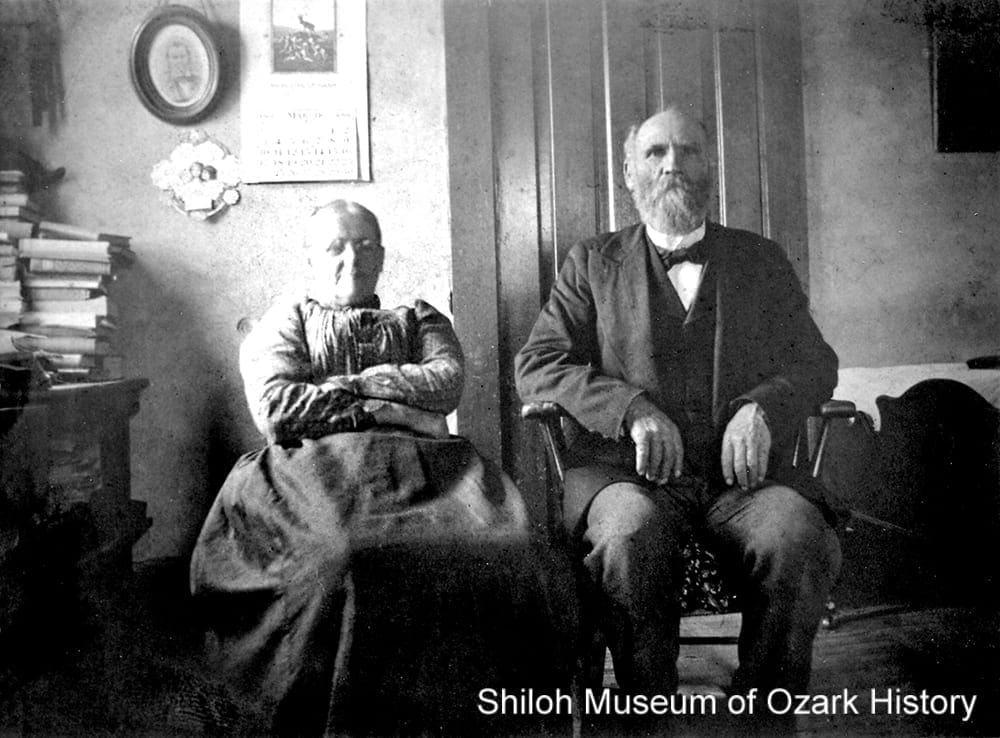
Rev. Peter Carnahan (1838-1926) and his wife, Martha Jane Buchanan Carnahan (1841-1922), at their home in Bentonville, 1890. Both Peter and Martha were descendants of pioneer Cumberland Presbyterian families who founded the Washington County settlement of Cane Hill in 1827. Rev. Carnahan became a minister in 1866 and served congregations in and around Cane Hill. In 1870 the Carnahan family moved to Bentonville, where Rev. Carnahan pastored the Presbyterian church for fourteen years.

Mildred Carnahan Collection (S-98-2-584)

Rev. Peter and Martha Carnahan, Bentonville, Arkansas, 1890

Rev. Peter Carnahan (1838-1926) and his wife, Martha Jane Buchanan Carnahan (1841-1922), at their home in Bentonville, 1890. Both Peter and Martha were descendants of pioneer Cumberland Presbyterian families who founded the Washington County settlement of Cane Hill in 1827. Rev. Carnahan became a minister in 1866 and served congregations in and around Cane Hill. In 1870 the Carnahan family moved to Bentonville, where Rev. Carnahan pastored the Presbyterian church for fourteen years.

Mildred Carnahan Collection (S-98-2-584)

Baptismal Font

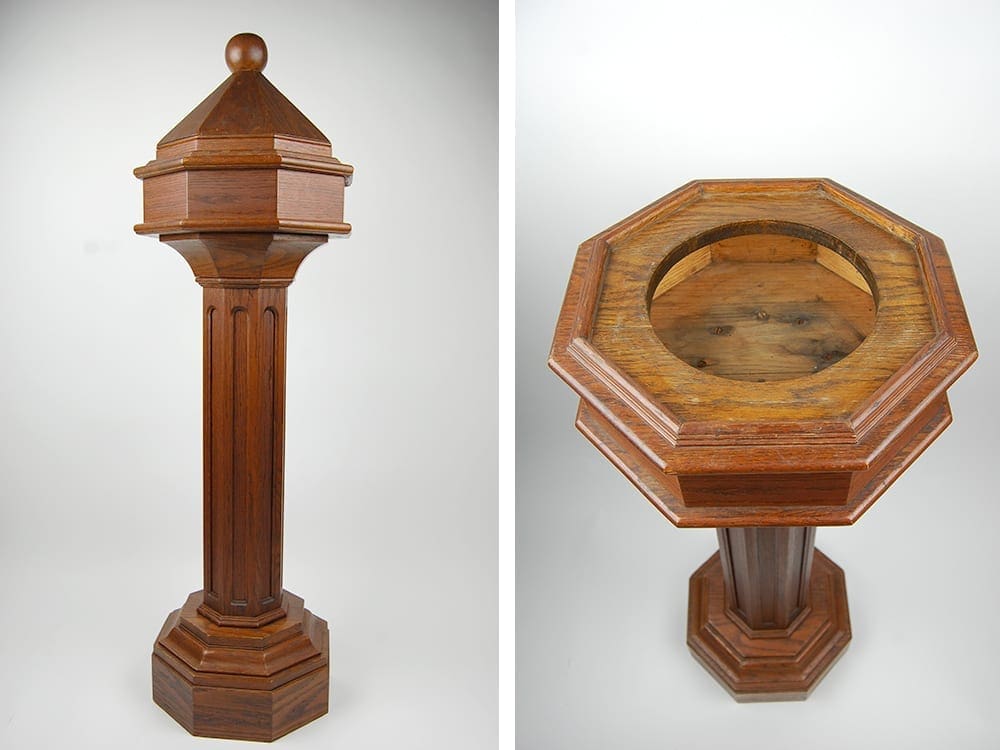
Baptismal font, Kingston, Presbyterian Church, Kingston, Arkansas, circa 1920s

Donated by Patricia Laird Vaughan

This free-standing wooden font originally included a metal water basin housed underneath the font’s conical lid. Water from the basin was used to perform the rite of baptism using a non-immersion method—by sprinkling, pouring, washing, or dipping.

In the early to mid 1900s, the Madison County town of Kingston was part of an outreach effort in the Appalachians and the Ozarks to improve the religious, social, and cultural life of mountain folk. In 1916, Rev. Elmer J. Bouher came to Arkansas from Indiana, tasked by the Presbyterian Church in the U.S.A. to revive an abandoned mission in Kingston. Construction of a New England colonial style building for the Kingston Community Church was completed in 1926, a project of the Board of Missions of the Presbyterian Church and the Brick Presbyterian Church of Rochester, New York.

In its heyday, the Kingston Community Church complex included a school, hospital, and community hall complete with a library, stage, bowling alley, kitchens, locker room, and showers. Interest in the project waned in the late 1930s, and the Board of Missions withdrew financial support in 1943. The owner of the buildings and property, the Brick Presbyterian Church, experienced financial difficulties in 1950. They decided to sell off all their mission holdings and offered the Kingston community the opportunity to purchase the land and buildings. Due to the poor condition of the properties the school board decided to construct a new school instead. The church was torn down soon thereafter.

In 1998, Patricia Laird Vaughan purchased the Kingston Community Church’s baptismal font at the Bunch Grocery Store auction in Kingston. Founded in 1880 by Joel N. Bunch, the store was located on the northwest corner of the Kingston square. It remained in the Bunch family for generations, serving the community as a center of commerce and later, a popular local gathering spot. The last storeowner, Hugh Bunch, died in 1995. At that time the Bunch Store closed; its contents were sold at auction in 1998. The building was purchased by Joel L. Bunch, great-grandson of the store’s founder, Joel N. Bunch.

Summers Depot

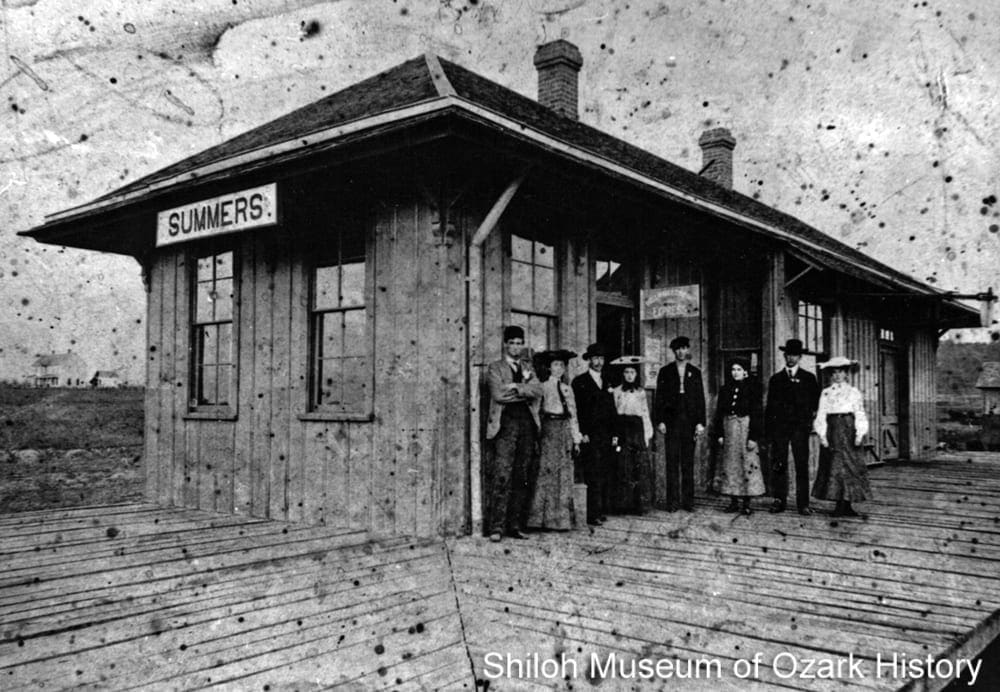
Ozark & Cherokee Central (O&CC)/Frisco Muskogee Branch Railway depot, Summers (Washington County), early 1900s. Constructed 1901–1903, the O&CC connected Fayetteville and Okmulgee, Indian Territory (Oklahoma). The O&CC was leased by the Frisco Railroad in 1903 and merged with the Frisco in 1907. The line became known as the Frisco Muskogee Branch. Passenger service on the Muskogee Branch ended in 1940; all rail operations between Fayetteville and Fort Gibson (just outside Muskogee) ended in 1942 and the tracks were pulled up to provide scrap metal for the war effort.

Jerry Risley Collection (S-87-343-2)

Frisco depot, Summers, Arkansas, early 1900s

Ozark & Cherokee Central (O&CC)/Frisco Muskogee Branch Railway depot, Summers (Washington County), early 1900s. Constructed 1901-1903, the O&CC connected Fayetteville and Okmulgee, Indian Territory (Oklahoma). The O&CC was leased by the Frisco Railroad in 1903 and merged with the Frisco in 1907. The line became known as the Frisco Muskogee Branch. Passenger service on the Muskogee Branch ended in 1940; all rail operations between Fayetteville and Fort Gibson (just outside Muskogee) ended in 1942 and the tracks were pulled up to provide scrap metal for the war effort.

Jerry Risley Collection (S-87-343-2)

Christmas Mouse

Donated by Ada Lee Shook

Eden Toys musical mouseMade by the New York-based Eden Toys, Inc., this musical mouse spins in a circle while playing “Deck the Halls.” It has a copyright date of 1982 and was sewn in Haiti. According to a 1981 newspaper article in the Millville (New Jersey) Daily, Eden’s board chairman David Miller explained that “the average stuffed toy takes 60 to 90 days to produce . . . because material must be cut, shipped [from Eden’s New Jersey factory] to South America or Haiti for stitching, and returned to the U.S. for finishing.”

A similar Eden Toys musical mouse is seen in a Belk’s Department Store ad in the December 21, 1984, Gaffney (South Carolina) Ledger, retailing for $16. The only difference between that mouse and the mouse pictured here is the outfit. The Belk’s mouse is wearing a striped nightshirt and cap.

Perhaps Eden Toys’ best known plush toy was Paddington Bear, the creation of British author Michael Bond. Other popular Eden toy lines included Beatrix Potter’s animal characters and Jean de Brunhoff’s Babar the Elephant animal characters. Eden Toys sold all its toy licenses in the early 2000s.

Ada Lee Smith Shook (1928–2009) was descended from pioneer families in Washington and Benton counties. Born in Fayetteville, she was the only child of William Carl Smith and Frances Slaughter Smith. Ada Lee graduated from Fayetteville High School in 1945, received a degree in mathematics from the University of Arkansas, and taught school for a time. She married William Eugene Shook in 1953. They raised two children. Ada Lee was an avid genealogist and saver of family heirlooms, many of which she donated to the Shiloh Museum.

Eden Toys musical mouse

Donated by  Ada Lee Shook

Made by the New York-based plush-toy manufacturer Eden Toys, Inc., this musical mouse spins in a circle while playing “Deck the Halls.” It has a copyright date of 1982 and was sewn in Haiti. According to a 1981 newspaper article in the Millville (New Jersey) Daily, Eden’s board chairman David Miller explained that “the average stuffed toy takes 60 to 90 days to produce . . . because material must be cut, shipped [from Eden’s New Jersey factory] to South America or Haiti for stitching, and returned to the U.S. for finishing.”

A similar Eden Toys musical mouse is seen in a Belk’s Department Store ad in the December 21, 1984, Gaffney (South Carolina) Ledger, retailing for $16. The only difference between that mouse and the mouse pictured here is the outfit. The Belk’s mouse is wearing a striped nightshirt and cap.

Perhaps Eden Toys’ best known plush toy was Paddington Bear, the creation of British author Michael Bond. Other popular Eden toy lines included Beatrix Potter’s animal characters and Jean de Brunhoff’s Babar the Elephant animal characters. Eden Toys sold all its toy licenses in the early 2000s.

Ada Lee Smith Shook (1928–2009) was descended from pioneer families in Washington and Benton counties. Born in Fayetteville, she was the only child of William Carl Smith and Frances Slaughter Smith. Ada Lee graduated from Fayetteville High School in 1945, received a degree in mathematics from the University of Arkansas, and taught school for a time. She married William Eugene Shook in 1953. They raised two children. Ada Lee was an avid genealogist and saver of family heirlooms, many of which she donated to the Shiloh Museum.

Finding Alsey Timberlake

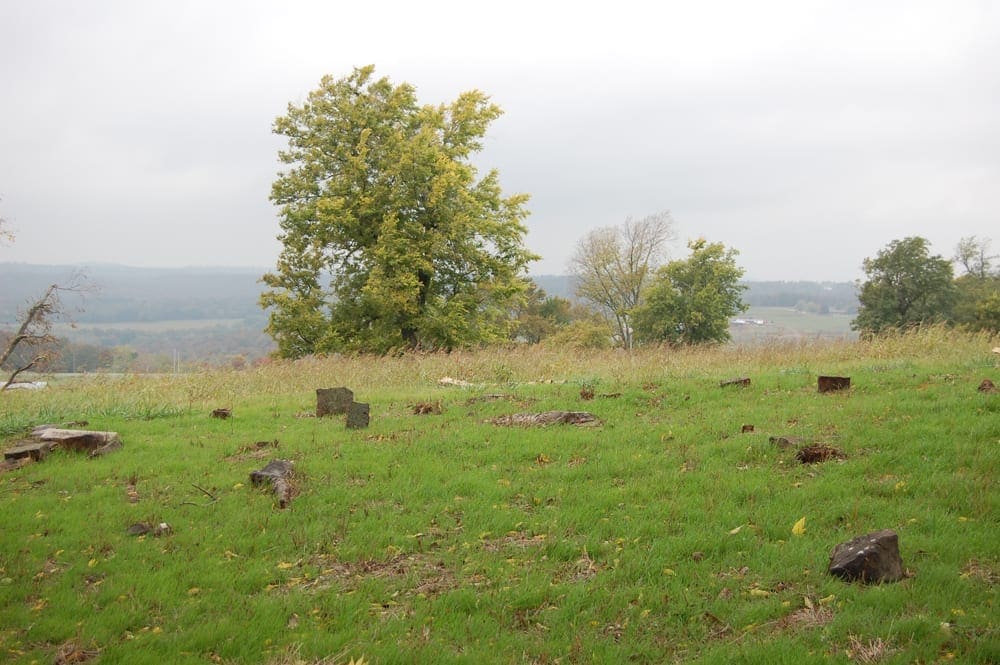
Carnahan Cemetery, looking west toward Oklahoma.

NOTE: This is an update of a blog originally published in 2013.

I recently participated in a driving tour of the west Washington County community of Cane Hill to get a sneak peek at preservation efforts being undertaken by the Historic Cane Hill organization. A highlight of the trip was a visit to Carnahan Cemetery, established with the burial of John Billingsley on Nov. 14, 1827. The old graveyard is high atop a windswept hill overlooking a lovely and expansive valley. To the west, seemingly just a stone’s throw away, is Oklahoma.

Immediately upon setting foot inside Carnahan Cemetery, I found myself transported back to 1837. On October 13 of that year, some 360 Cherokees led by Lt. B. B. Cannon left the Cherokee Agency in Tennessee bound for Indian Territory. They were going voluntarily as members of the “Treaty Party,” a small group of Cherokees who supported the Treaty of New Echota ceding all Cherokee land east of the Mississippi River in exchange for $5 million and land in Indian Territory (present-day Oklahoma). Most Cherokees protested the Treaty of New Echota and refused to leave their ancestral homeland. This faceoff with the federal government resulted in the forced removal of thousands of Cherokees, a dark time in our history known as the Trail of Tears.

The Cannon detachment traveled overland through Tennessee, Kentucky, Illinois, Missouri, and Arkansas on their trek to Indian Territory, arriving there December 27, 1837. Sickness and death accompanied them along every step of the ten-week journey. It is heartbreaking to read B. B. Cannon’s journal and his stark mentions of death along the way. Seventeen people lost their lives: fourteen children (including one “black boy”) and three adults.

For the Charles Timberlake family, the journey was horrific. Smoker Timberlake, age about eleven, was buried on December 17, 1837, after the detachment passed through Springfield, Missouri. Ten days later, on December 27, Smoker’s thirteen-year-old sister, Alsey, was buried somewhere near Cane Hill, Arkansas. The next day, December 28, another Timberlake child (whose name was unrecorded by Cannon) was buried in Indian Territory, most likely in the vicinity of present-day Stilwell, Oklahoma.
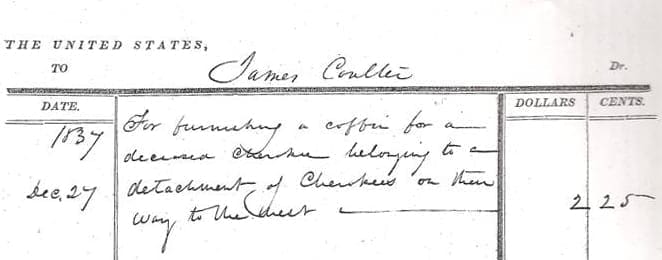
Receipt to James Coulter showing payment of $2.25 “for furnishing a coffin for a deceased Cherokee belonging to a detachment of Cherokees on their way to the west.” National Archives and Records Administration

A receipt discovered in the National Archives by members of the Oklahoma Chapter of the National Trail of Tears Association shows payment of $2.25 on December 27, 1837, to James Coulter of Cane Hill “for furnishing a coffin for a deceased Cherokee belonging to a detachment of Cherokees on their way to the west.” December 27, 1837the day B. B. Cannon recorded the burial of Alsey Timberlake. The “deceased Cherokee” listed in the James Coulter receipt is thirteen-year-old Alsey Timberlake.

Land records show that James Coulter didn’t live too far from Carnahan Cemetery. Could this old burial ground be the final resting place of Alsey Timberlake? We’ll probably never know for sure. But I can tell you one thing for certain. On that day, in that place, high atop a hill looking west toward Oklahoma, Alsey Timberlake was right there with me.

Susan Young is the Shiloh Museum’s outreach coordinator. 

“U.S. Presidents” Volvelle

US Presidents volvelle, circa 1931Donated by  Bill Stamper

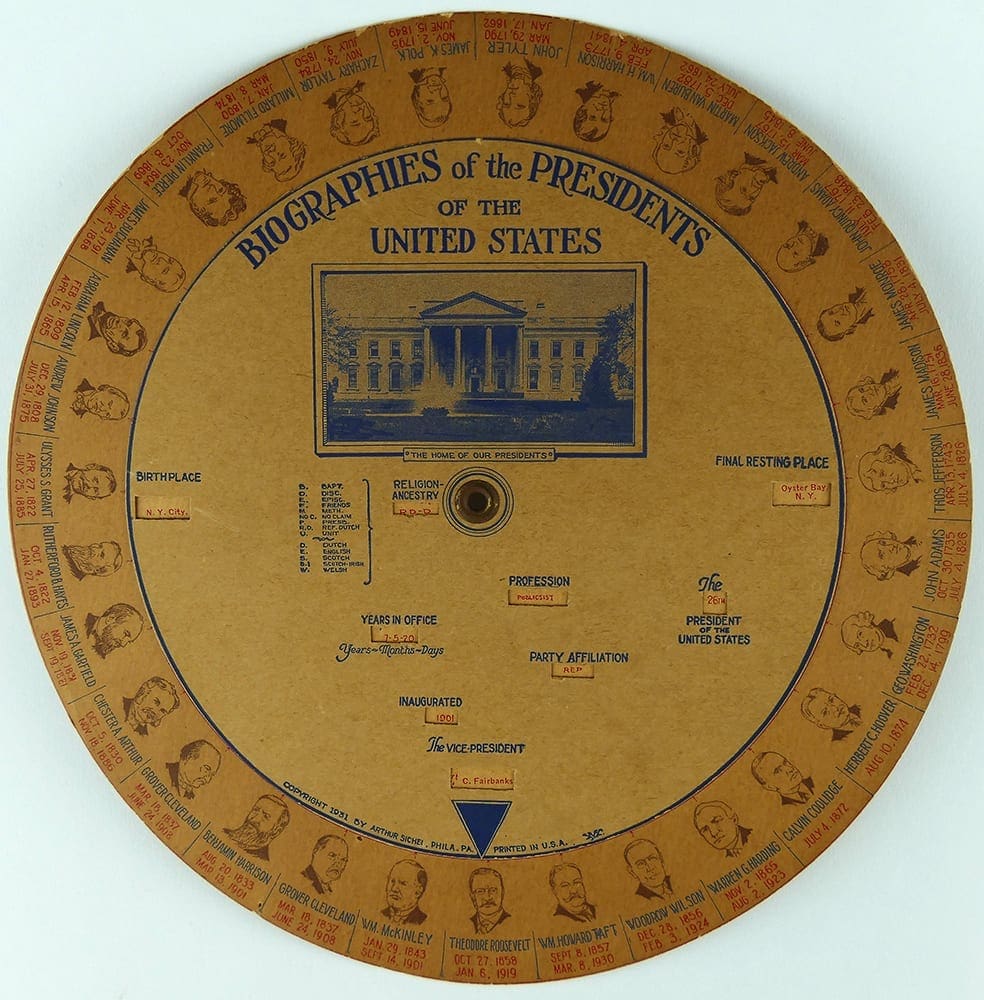
As Emily Marinker of the New York Academy of Medicine writes, “[A volvelle is] a (brilliantly) simple paper construction of moving parts; layers of rotating discs with information on them.”

This “Biographies of U.S. Presidents” volvelle was produced by Arthur Sichel of Philadelphia, Pennsylvania, and has a copyright date of 1931. Information for each president includes birthplace, religion, ancestry, years in office, inauguration year, the order in which he served, party affiliation, profession before becoming president, final resting place, and the vice president who served with him. The religions listed on the volvelle include Baptist, Disciples of Christ, Episcopal, Society of Friends (Quaker), Methodist, No Claim, Presbyterian, Reformed Dutch, and Unitarian. Five ancestries are listed: Dutch, English, Scotch, Scotch-Irish, and Welsh. Below each president’s image is his name, birth date, and death date. 

A German immigrant, Arthur Sichel (1887–1955) arrived in America in 1903, settled in Pennsylvania, became a naturalized citizen of the U.S. in 1927, and married Kamma Riegelsen from Denmark in 1932.  In the 1930 census, Arthur Sichel listed his occupation as  “advertising salesman.”

The volvelle was found by the donor when he bought the former home of the John A. and Margaret Long Phillips family of Huntsville (Madison County). John Phillips served as Madison County’s sheriff from 1926 until he was shot and killed by 80-year-old county resident Jason Matlock on December 22, 1930. Sheriff Phillips less than ten days left in office; Arkansas Governor Henry Parnell appointed Margaret Phillips to finish out her husband’s term. According to the Madison County Record (December 30, 1930), as she “assisted [Sheriff Phillips] all the time with the clerical duties of the office and is better qualified than anyone else to wind up the affairs in the office. She will appoint deputies to look after any work outside needing attention.”

U. S. Presidents volvelle, 1931

Donated by  Bill Stamper

As Emily Marinker of the New York Academy of Medicine writes, “[A volvelle is] a (brilliantly) simple paper construction of moving parts; layers of rotating discs with information on them.”

This “Biographies of U.S. Presidents” volvelle was produced by Arthur Sichel of Philadelphia, Pennsylvania, and has a copyright date of 1931. Information for each president includes birthplace, religion, ancestry, years in office, inauguration year, the order in which he served, party affiliation, profession before becoming president, final resting place, and the vice president who served with him. The religions listed on the volvelle include Baptist, Disciples of Christ, Episcopal, Society of Friends (Quaker), Methodist, No Claim, Presbyterian, Reformed Dutch, and Unitarian. Five ancestries are listed: Dutch, English, Scotch, Scotch-Irish, and Welsh. Below each president’s image is his name, birth date, and death date. 

A German immigrant, Arthur Sichel (1887–1955) arrived in America in 1903, settled in Pennsylvania, became a naturalized citizen of the U.S. in 1927, and married Kamma Riegelsen from Denmark in 1932.  In the 1930 census, Arthur Sichel listed his occupation as  “advertising salesman.”

The volvelle was found by the donor when he bought the former home of the John A. and Margaret Long Phillips family of Huntsville (Madison County). John Phillips served as Madison County’s sheriff from 1926 until he was shot and killed by 80-year-old county resident Jason Matlock on December 22, 1930. Sheriff Phillips less than ten days left in office; Arkansas Governor Henry Parnell appointed Margaret Phillips to finish out her husband’s term. According to the Madison County Record (December 30, 1930), as she “assisted [Sheriff Phillips] all the time with the clerical duties of the office and is better qualified than anyone else to wind up the affairs in the office. She will appoint deputies to look after any work outside needing attention.”

NEWSLETTER