Pumping Water

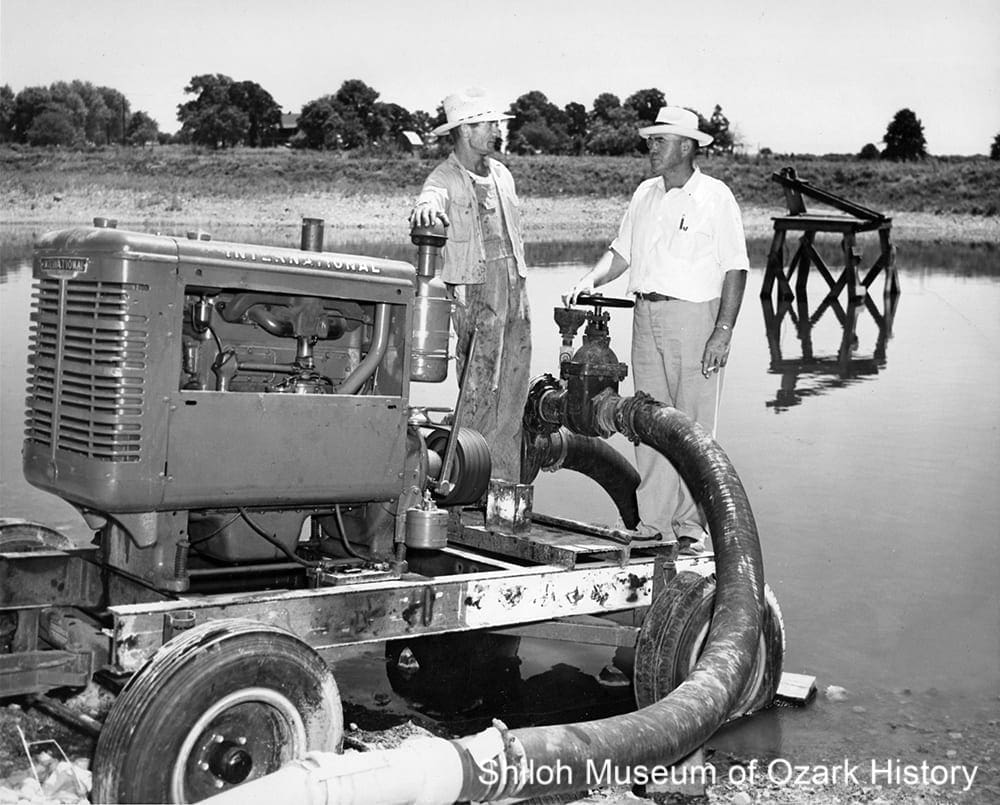
Tom Farish (right) and an identified worker at a irrigation pond in Lowell (Benton County), July 1946. The portable pump was sending much-needed water to fields of green beans. Farish and Joe Steele were co-owners of Steele Canning Company, regional processors of beans, tomatoes, and spinach.

Maudine Sanders Collection (S-2006-132-152)

Tom Farish (right) and an identified worker at a irrigation pond in Lowell (Benton County), July 1946. The portable pump was sending much-needed water to fields of green beans. Farish and Joe Steele were co-owners of Steele Canning Company, regional processors of beans, tomatoes, and spinach.

Maudine Sanders Collection (S-2006-132-152)

Restroom Recuerdos

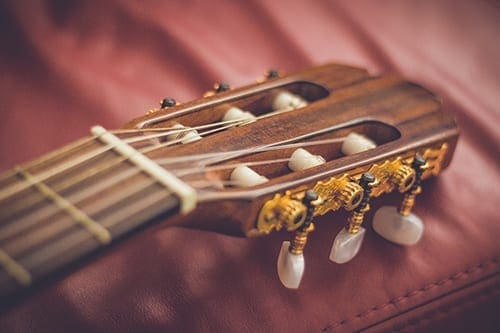
Photo by Marcin Nowak on Unsplash

Working in and around museums for well over twenty years has jaded me somewhat. Considering all the cool and different stuff we get to experience, it’s rare that something really surprises me. Then I turned the corner into the men’s room at the Shiloh Museum and heard . . . Spanish classical guitar music? I was convinced I was dreaming or hallucinating, because there was no other way to make sense of the sound that I thought was coming from the men’s room, and here’s why.

I love to search for and listen to solo acoustic guitar performances. There are many flavors, old and new, from Spanish classical and flamenco to New Age stuff with names like “percussive acoustic” or “heavy wood.” Not what you normally encounter in Northwest Arkansas, but it’s often the soundtrack in my head. YouTube is about the only place to search for these genres. Just one performer, one instrument, no overdubs, no multi-tracks, but it often sounds like a group of players. It’s a tour de force sort of thing—musicians showing off because they can, and I love to listen. I’ll occasionally attempt to play a feeble line or two, just enough to appreciate the challenge. My family suffers much, but I digress.

Since I’m in a restroom in Arkansas and not on a street corner in Seville, my logical conclusion was that these familiar sounds were all in my head. But rounding the corner in the men’s room, I find a nicely dressed young man perched on a chair, scrunched over his Spanish Classical styled guitar, with his right foot propped on a tiny stool. He’s playing “Recuerdos de la Alhambra” by Francisco Tárrega, and he’s killing it. The acoustics in the bathroom are shockingly good. Startled by my sudden appearance, the young virtuoso was quick to apologize for invading my, um, space. I was quick to encourage him to keep playing, and asked if he would take requests!

In what sounded to me like a high Castilian accent, the musician explained that he had found a quiet spot to practice for a concert later that evening, just up the road at the Arts Center of the Ozarks (ACO). It wasn’t until much later that I learned he was part of a group of world-class musicians, winners of an international competition held in Ragusa, Italy. The contest is sponsored by the IBLA Foundation in New York, and the grand prize winners participate in a world concert tour. They play such prestigious venues as the Lincoln Center and Carnegie Hall in New York, the Tokyo Opera City Hall, and the Tchaikovsky Bolshoi Hall in Moscow, with a sprinkling of other venues across the United States. It’s a big deal, and we’re lucky that the IBLA performers have played in an Arkansas venue for the last eighteen years, luckier still that they wound up playing the ACO in Springdale.

Turns out the young guitarrista with the intriguing accent did take requests—he played everything I could remember from my mental list of classical selections. His take on Issac Albéniz’s “Leyenda” (“Asturias”) was superb—both the traditional Segovia-styled version, AND a faster and technically precise rendition in the manner of modern Croatian artist Ana Vidovic. Wore me out just watching. I was deeply impressed and humbled.

Fate had other plans for my evening, so I was bummed about missing the concert. It’s OK though, I enjoyed a neat little micro-performance in the most unlikely of places. And the acoustics were wonderful.

Curtis Morris is the Shiloh Museum’s exhibits manager.


Pillow Sham

Donated by Norman and Elsie Young

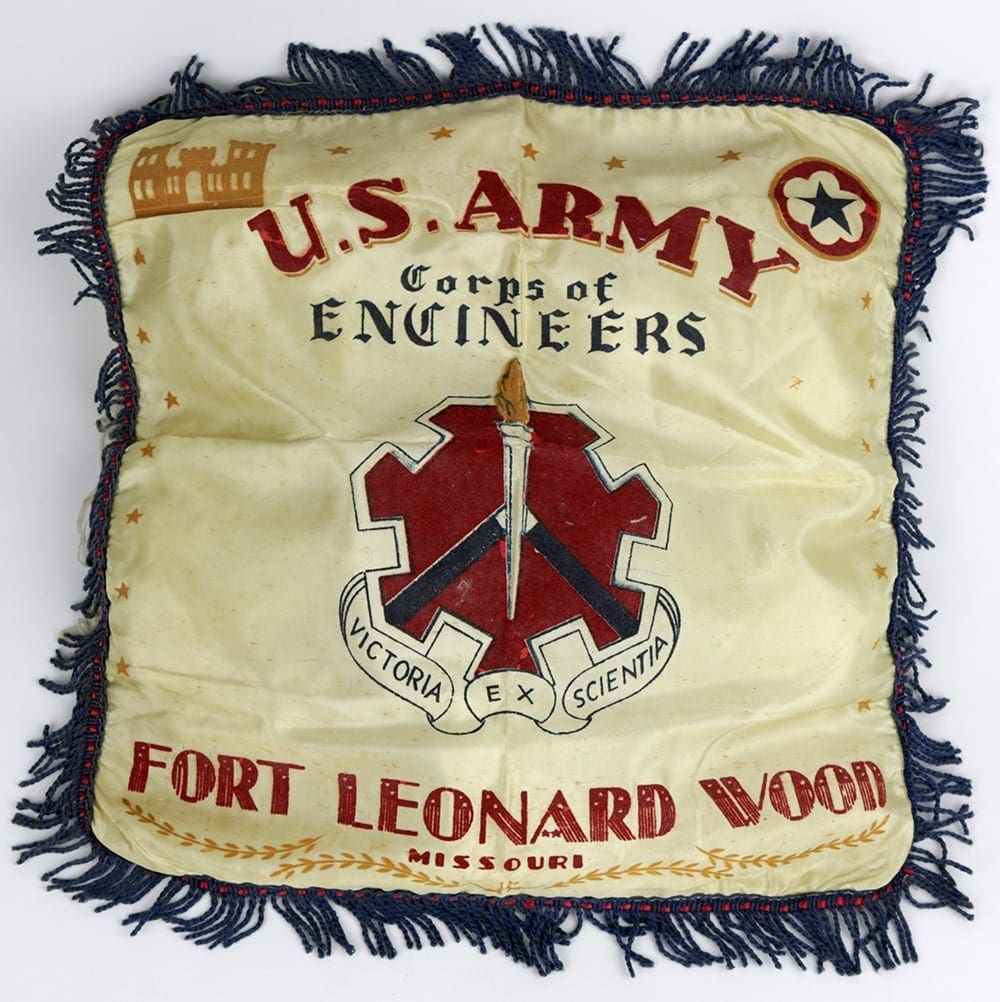
During World War II, souvenir pillow shams were popular gifts sent from soldiers to family and friends back home. This sham boasts a golden castle in the upper left hand corner, the symbol for the Army Corps of Engineers. In the upper right corner, the blue star on a red and white background is a symbol used by the Army Service Forces from March 9, 1942 through June 11, 1946. The large symbol in the center of the sham represents Fort Leonard Wood’s Engineer Replacement Training Center. The phrase “Victoria Ex Scientia” means “Victory from Knowledge.”

Norman Young (1913-1989) was born near the Madison County community of Wesley. He enlisted in the Army in 1943, trained at Fort Leonard Wood in Missouri, and served with the Army Corps of Engineers. Young’s overseas tour of duty took him to Italy.

PFC Norman Young was discharged from service on October 17, 1945. He returned home to Northwest Arkansas, married Elsie Cress, and worked as a custodian at the University of Arkansas.

Donated by Norman and Elsie Young

During World War II, souvenir pillow shams were popular gifts sent from soldiers to family and friends back home. This sham boasts a golden castle in the upper left hand corner, the symbol for the Army Corps of Engineers. In the upper right corner, the blue star on a red and white background is a symbol used by the Army Service Forces from March 9, 1942 through June 11, 1946. The large symbol in the center of the sham represents Fort Leonard Wood’s Engineer Replacement Training Center. The phrase “Victoria Ex Scientia” means “Victory from Knowledge.”

Norman Young (1913-1989) was born near the Madison County community of Wesley. He enlisted in the Army in 1943, trained at Fort Leonard Wood in Missouri, and served with the Army Corps of Engineers. Young’s overseas tour of duty took him to Italy.

PFC Norman Young was discharged from service on October 17, 1945. He returned home to Northwest Arkansas, married Elsie Cress, and worked as a custodian at the University of Arkansas.

Frisco Coaling Tower

Frisco Railroad coaling tower at Fayette Junction, a switchyard that was located near the present-day intersection of Cato Springs Road and Vale Avenue in south Fayetteville, early 1900s.

Virginia Threet Collection (S-88-156-11)

Frisco Railroad coaling tower at Fayette Junction near Fayetteville, Arkansas, early 1900s.

Coaling towers were a necessary fixture along railroads during the era of coal-powered steam locomotives. Coal was carried on the train in a special car called a “tender.” When the tender needed to be refilled, the engineer positioned the train so that the tender was parked under the tower chutes at the coaling tower. The chutes were then lowered and coal was released into the tender. In the 1950s, diesel replaced coal as the fuel of choice for locomotives, and coaling towers fell out of use.

Frisco Railroad coaling tower at Fayette Junction near Fayetteville, Arkansas, early 1900s.

Frisco Railroad coaling tower at Fayette Junction, a switchyard that was located near the present-day intersection of Cato Springs Road and Vale Avenue in south Fayetteville, early 1900s.

Coaling towers were a necessary fixture along railroads during the era of coal-powered steam locomotives. Coal was carried on the train in a special car called a “tender.” When the tender needed to be refilled, the engineer positioned the train so that the tender was parked under the tower chutes at the coaling tower. The chutes were then lowered and coal was released into the tender. In the 1950s, diesel replaced coal as the fuel of choice for locomotives, and coaling towers fell out of use.

Virginia Threet Collection (S-88-156-11)

Bustle

Donated by Annabel Searcy

Bustles were used mainly in the mid-to-late nineteenth century to expand and support the back of a woman’s dress. This “Taylor’s Cushion No. 2” woven wire bustle dates from the early 1900s, fairly late in the lifespan of these padded undergarments. By the early 1910s, the bustle had been replaced by the long corset which shaped more of the body then just the back of the dress.

View Henry H. Taylor’s 1900 bustle patent.

Taylor;s No. 2 Bustle

Donated by Annabel Searcy

Bustles were used mainly in the mid-to-late nineteenth century to expand and support the back of a woman’s dress. This “Taylor’s Cushion No. 2” woven wire bustle dates from the early 1900s, fairly late in the lifespan of these padded undergarments. By the early 1910s, the bustle had been replaced by the long corset which shaped more of the body then just the back of the dress.

View Henry H. Taylor’s 1900 bustle patent.

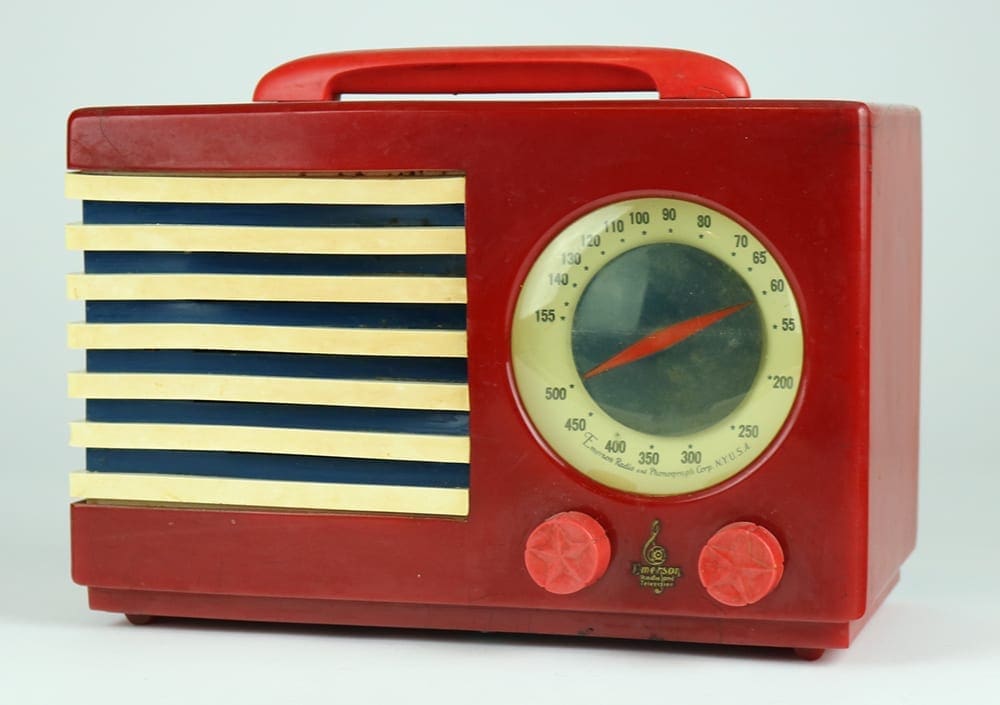
Emerson “Patriot” Radio

Donated by Ada Lee Shook

This radio belonged to the Carl Smith family of Fayetteville.

In 1940, with U. S. involvement in World War II on everyone’s mind, Emerson Radio and Phonograph Company and industrial designer Norman Bel Geddes came out with the “Patriot” radio in red, white, and blue colors. The cabinet is made of catalin, a type of plastic similar to bakelite. Patriots retailed for $24.95.

Emerson "Patriot" Radio

Donated by Ada Lee Shook

This radio belonged to the Carl Smith family of Fayetteville.

In 1940, with U.S. involvement in World War II on everyone’s mind, Emerson Radio and Phonograph Company and industrial designer Norman Bel Geddes came out with the “Patriot” radio in red, white, and blue colors. The cabinet is made of catalin, a type of plastic similar to bakelite. Patriots retailed for $24.95.

Taste of Tontitown

Nova Jean Fiori Watson flouring a rolled-out sheet of pasta, May 2018.

Nova Jean Fiori Watson flouring a rolled-out sheet of pasta, May 2018.

Ravioli was on my mind during a phone conversation with Nova Jean Fiori Watson. That’s not why I called her, but as we finished our business I had to ask, “Did your mother make ravioli?” I was curious because I have a circle of friends who love to cook and our next project together was ravioli.

Nova Jean has a life-long love of the Italian food she grew up with. Her paternal grandparents were Maria “Mary” Cortiana and Pietro “Pete” Fiori. Born in Italy, they came to Northwest Arkansas as young children in 1898 with their families and other Italian settlers, under the leadership of Father Pietro Bandini. Together these immigrants founded the farming community of Tontitown, west of Springdale.
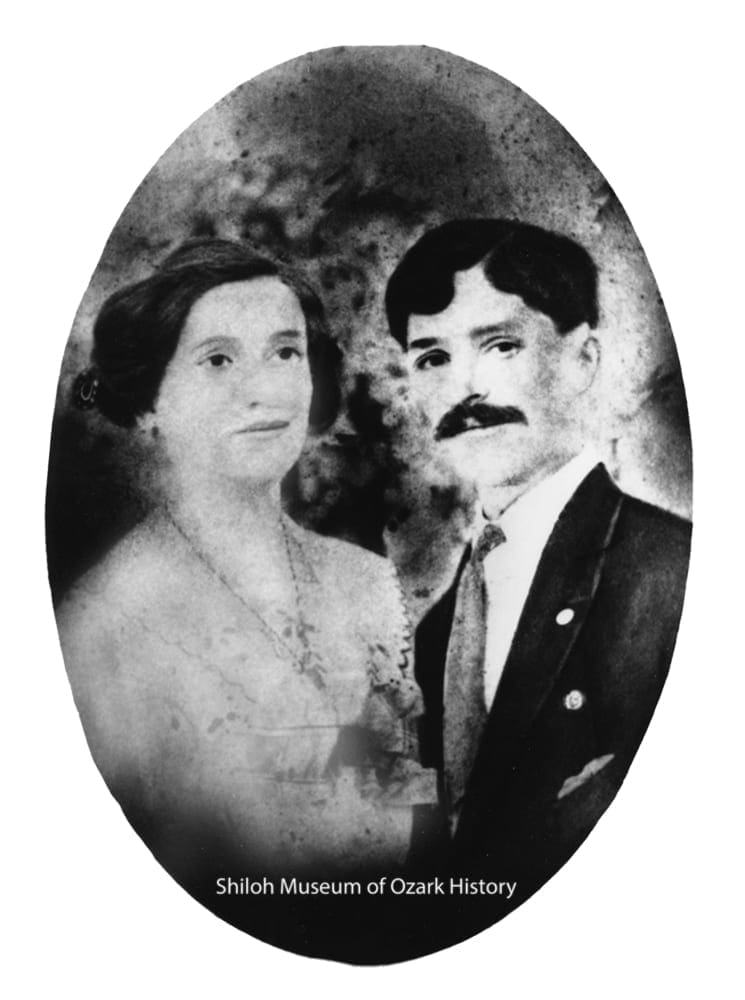
Maria "Mary" Cortiana Fiori and Pietro "Pete" Fiori, 1912.

Maria “Mary” Cortiana Fiori and Pietro “Pete” Fiori, 1912. Elsie Mae Fiori Pianalto Collection (S-2003-2-736)

When she was a child, Nova Jean lived with Nona Mary and Nono Pete during the school year. In an article she wrote for the Tontitown Storia (Spring 2007), Nova Jean said that she “looked forward to the day Nona baked bread, because we would have fried bread and [home-canned] peaches for lunch.  It was sooo good.”  When Nona’s grandsons had free time, she had them kill the sparrows roosting in her brooder houses with their BB guns. “She called them ‘Chee Chee Birds.’ She would skin them, clean them and cut off just the beaks, leaving the heads. She prepared hers in the oven with oil, sage, and garlic. They were delicious. How sad that none of us bothered to learn the recipe.” In a recent email, Nova Jean recalled another specialty of Nona’s—homemade soup, which she “always started with salt pork grease from a crock in the cellar, which was replenished each time the family butchered a hog.”
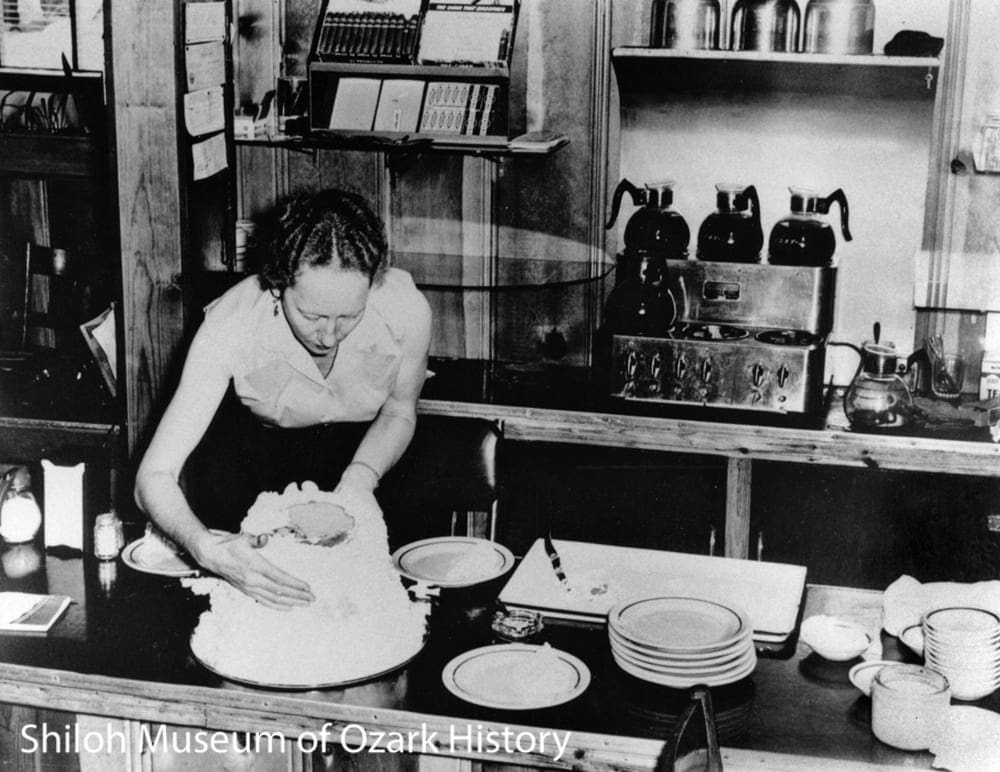
Fern Haney Fiori adjusting the cake she's cutting slices from at the wedding reception for Luellen Penzo and James "Jim" Weiss, Venesian Inn, Tontitown, March 10, 1955.

Fern Haney Fiori adjusting the cake she’s cutting slices from at the wedding reception for Luellen Penzo and James “Jim” Weiss, Venesian Inn, Tontitown, March 10, 1955. Luellen Penzo Weiss Collection (S-2011-100-1)

Years later, after Nova Jean and her husband Danny Ray Watson retired and moved back to Tontitown, Nova Jean’s mother Fern came to live with them. Fern Haney Fiori grew up in an Irish family in nearby Elm Springs where, according to Nova Jean, “the teenagers and young adults mixed with the same from Tontitown.  They would mostly dance at someone’s home or any place large enough to accommodate the crowd, any place within walking distance for both communities.” In 1934 Fern married Pete & Mary’s son, Bill Fiori. Over the years Fern learned to cook a few Italian dishes from the ladies in the community.  Fern and Nova Jean had many conversations about food. In 1992 she asked her mother about the chicken filling she made for ravioli.  In a shaky hand Fern wrote, “Boil chickens pick off bone…”

I think Nova Jean and I are kindred spirits in the kitchen. Not just the joy of cooking, but exploring and cherishing the memories and histories behind the recipes.  One of the other Italian foods she’s researched is a sweet bread made at Easter, locally known as fugase. In the early 1990s she collected recipes from several Tontitown ladies including her paternal aunt, Elsie Mae Fiori Pianalto. Maybe Nova Jean and I can get together to make bread someday. Until then, I’ll enjoy making chicken ravioli. Here’s the recipe, so you can taste a bit of history, too.  Buon appetito!
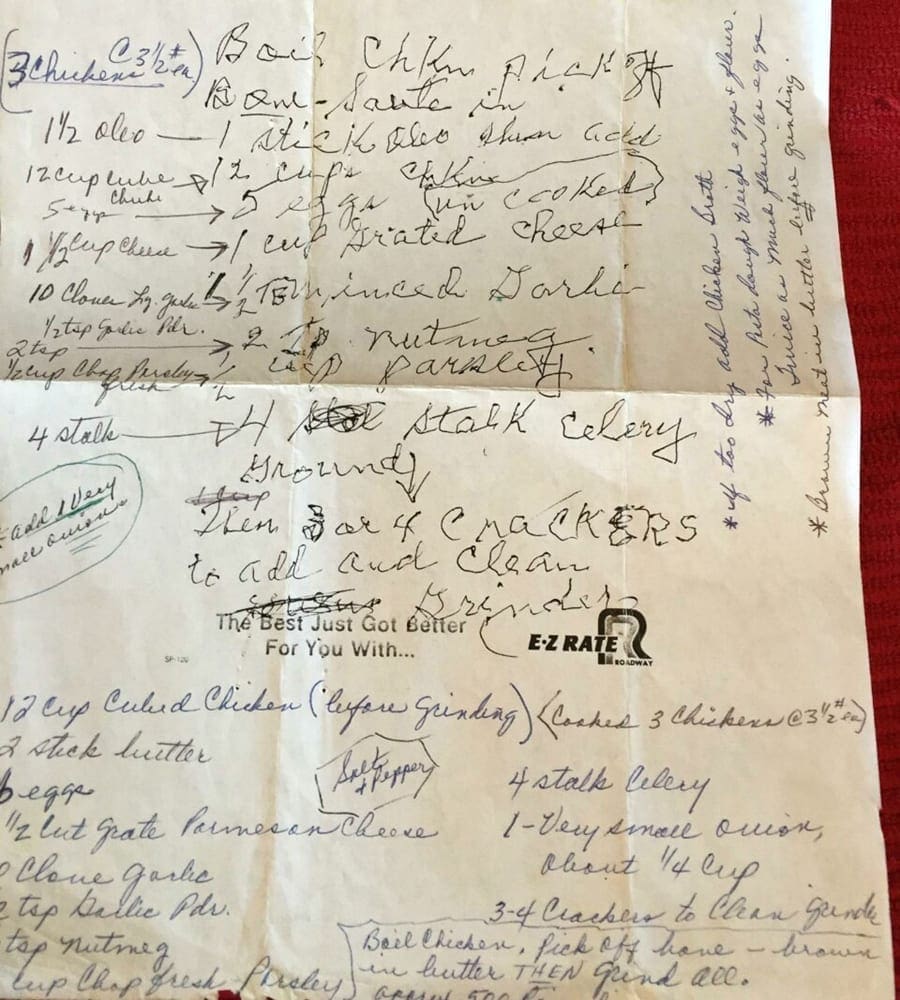
Fern Haney Fiori's recipe for chicken ravioli, with Nova Jean Fiori Watson's notations, 1992.

Fern Haney Fiori’s recipe for chicken ravioli, with Nova Jean Fiori Watson’s notations, 1992. Courtesy Nova Jean Fiori Watson.

Fern Haney Fiori’s Chicken Ravioli
This is Nova Jean’s version of her mother’s recipe, scaled down from the three chickens it originally called for. Serve the cooked ravioli with a bit of red sauce (marinara) or en brodo (in broth).  Makes about 56 ravioli or four meal-sized servings.

Filling (makes 4 cups of filling)

4 cups cooked, boneless chicken meat, broken into pieces

4 tablespoons (one-half stick) of salted butter

1 celery rib, chopped into small chunks (about 1/2 cup)

1 small onion, chopped into small chunks (about 1/2 cup)

1 clove garlic

1 tablespoon fresh Italian flat-leaf parsley

2 saltine-type crackers

1/3 cup grated parmesan cheese, plus more for garnishing

1 teaspoon nutmeg

Salt & pepper

1 large egg

1-2 tablespoons chicken broth or water

Pasta Dough (makes 1 3/4 pound of dough)

3 large eggs

2 1/2 cups flour

To make the filling, melt two tablespoons butter in a sauté pan over medium heat.  Lightly brown half of the chicken and remove.  Repeat with the remaining chicken and butter. (If the chicken is browned too deeply, it will make the filling gritty.)  Once the meat is cool, grind it in a meat grinder, alternating with the celery, onion, garlic, and parsley.  Add the crackers last, to clear out the grinder.  (If using a food processor, pulse the meat and vegetables separately until chopped fine; do not puree.)

Add the cheese, nutmeg, salt, and pepper to the ground mixture and blend thoroughly. Taste and adjust the seasonings, as needed. Add the egg and one tablespoon or two of broth or water to make a loose, but not wet, mix.

To make the pasta dough, place the eggs into a large bowl and whisk with a fork. Add the flour and mix until the dough comes together into a shaggy ball. Squeeze some of the dough in your hand to see if it holds together. If so, knead the dough on the counter for a few minutes until smooth. If not, for a crumbly dough, add a little chicken broth or water. For a sticky dough, add a bit of flour. The proportion of egg to flour is 1:2 (one part egg by weight, two parts flour by weight).

Roll out the pasta dough into sheets and form the ravioli, using a tablespoon of chicken filling per raviolo (the singular form of ravioli). Cook the ravioli in simmering chicken broth for 3-7 minutes, until the pasta is al dente. Serve the ravioli with broth or with a red sauce.  Garnish with parmesan cheese.
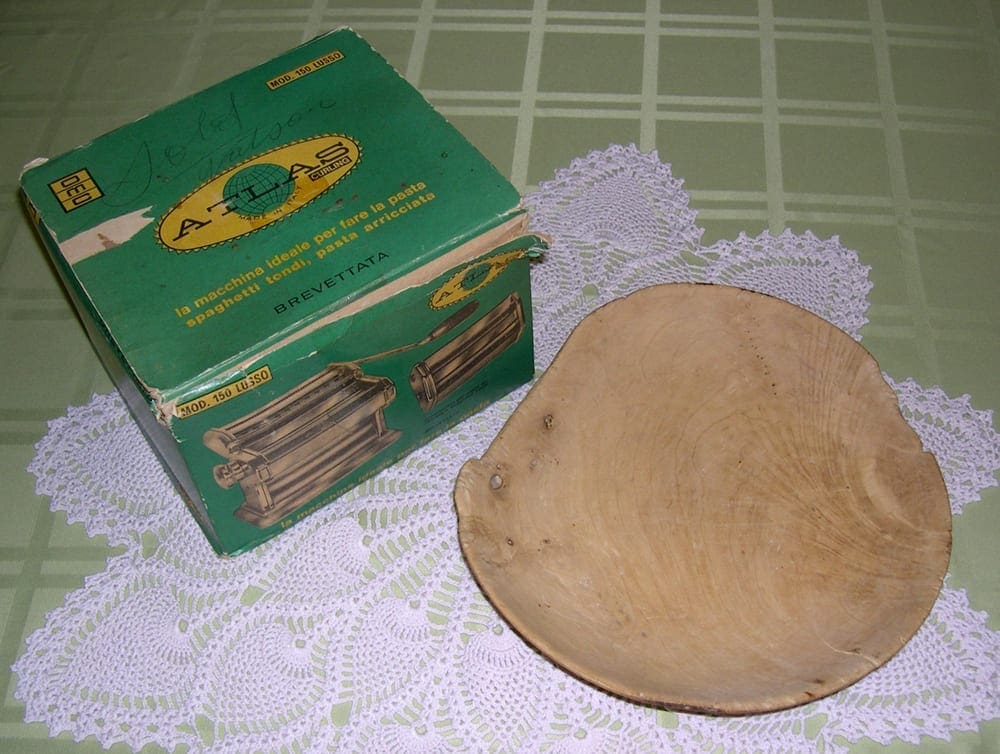
Nova Jean Fiori Watson's Atlas pasta maker, bought in 1960, and the well-worn dough bowl that belonged to her paternal grandmother Maria "Mary" Cortiana Fiori.

Nova Jean Fiori Watson’s Atlas pasta maker, bought in 1960, and the well-worn dough bowl that belonged to her paternal grandmother Maria “Mary” Cortiana Fiori.

NOTE:  There are plenty of recipes and videos on the Internet for making chicken broth and red sauce (marinara), rolling out pasta dough, and forming ravioli.

Marie Demeroukas is the Shiloh Museum’s photo archivist/research librarian.



Highway 12 Bridge

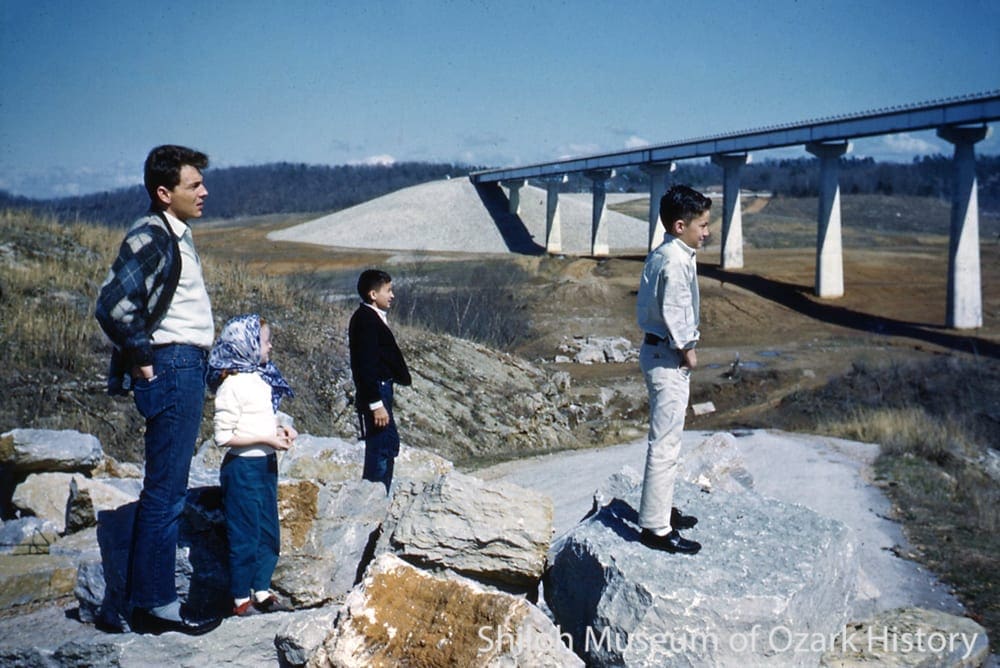
Bobby Smitherman (from left), with Debbie, Greg, and Mike Mohney, take a look at the new Highway 12 bridge spanning the White River valley east of Rogers, soon to be Beaver Lake, circa 1964.

Bettye Mohney Collection (S-86-124-38-24)

Highway 12 bridge during construction of Beaver Lake, 1964

Bobby Smitherman (from left), with Debbie, Greg, and Mike Mohney, take a look at the new Highway 12 bridge spanning the White River valley east of Rogers, soon to be Beaver Lake, circa 1964.

Bettye Mohney Collection (S-86-124-38-24)

Pencil Box

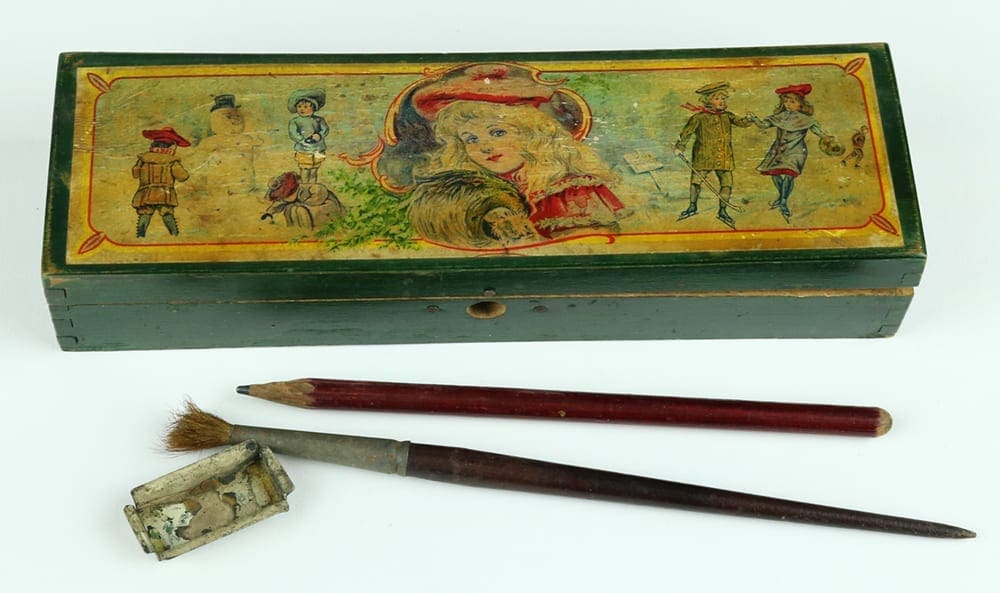
This pencil box belonged to Claud McCuistion of Rogers, who died in November 1919 at the age of thirteen due to injuries sustained in a runaway wagon accident. He is buried in Fayetteville’s Mount Comfort Cemetery in Fayetteville.

The contents of the pencil box are as Claud left them.

This pencil box belonged to Claud McCuistion of Rogers, who died in November 1919 at the age of thirteen due to injuries sustained in a runaway wagon accident. He is buried in Fayetteville’s Mount Comfort Cemetery in Fayetteville.

The contents of the pencil box are as Claud left them.

NEWSLETTER